

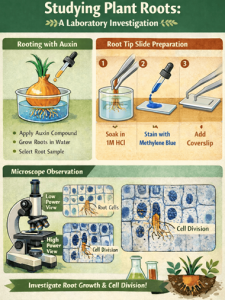
Understanding plant hormones becomes much clearer for students when they connect hormone function directly to visible growth patterns, especially in roots of actively dividing tissues. In this classroom activity, students explore how auxin promotes root initiation, then view the dividing cells with a microscope.
The introductory text explains how plant hormones work to stimulate root growth. Then describes the process of plant propagation via asexual reproduction. Students get a hands-on experience by applying auxin to onion roots to stimulate their growth.
After a few days, new roots will develop. Students then harvest the roots and apply HCL, which helps to break down the cell walls in order to separate individual cells that can be viewed with a microscope. Afterwards, students create a wet-mount of the roots and stain with methylene blue.
The analysis and synthesis questions explore further instances of how auxin stimulates plant growth in response to gravity and light (phototropism).
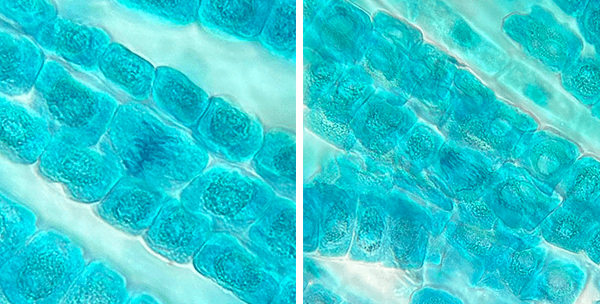
I also have prepared slides of mitosis for students to compare the ones they created to professionally sourced specimens. In both cases, students should clearly be able to cell cells undergoing mitosis. They should note that the majority of the cells are still in interphase (where the cell spends most of its life cycle.)
Materials are easy to acquire: onions can be purchased from the grocery store and auxins are sold as rooting powder. Methylene blue is used in other laboratory exercises, like the cheek cell staining lab.
Related Activities
Mitosis Coloring – learn about the phases of mitosis with this coloring sheet
Investigation – Mitosis and Cancer – a case study combined with a lab to view cells; explores mitotic index
Case Study – Mitosis, Cancer, and HPV – explores how disruptions in the cell cycle can lead to cancer
Cell Cycle Labeling – a graphic showing the phases of mitosis, students label the phases and cell components