
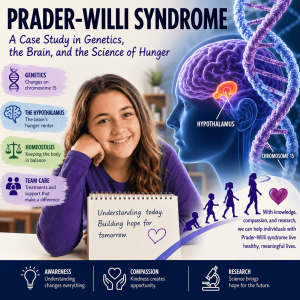
Rare genetic disorders provide some of the best opportunities for students to see how multiple body systems work together. While many lessons teach genetics, the nervous system, or the endocrine system separately, Prader-Willi syndrome (PWS) demonstrates how a single genetic change can affect nearly every aspect of human physiology.
This case study follows Ella, an eleven-year-old girl whose life has been shaped by a condition that causes her to feel hungry almost all the time. Rather than simply presenting facts, students uncover her diagnosis through a story that mirrors the way physicians approach real patients, observing symptoms, gathering evidence, and connecting biology concepts to explain what is happening inside the body.
The case begins with Ella’s daily struggles. Her family locks the refrigerator, carefully plans meals, and works with a team of healthcare professionals to manage her condition. As students read, they discover that Ella’s symptoms began long before her constant hunger.
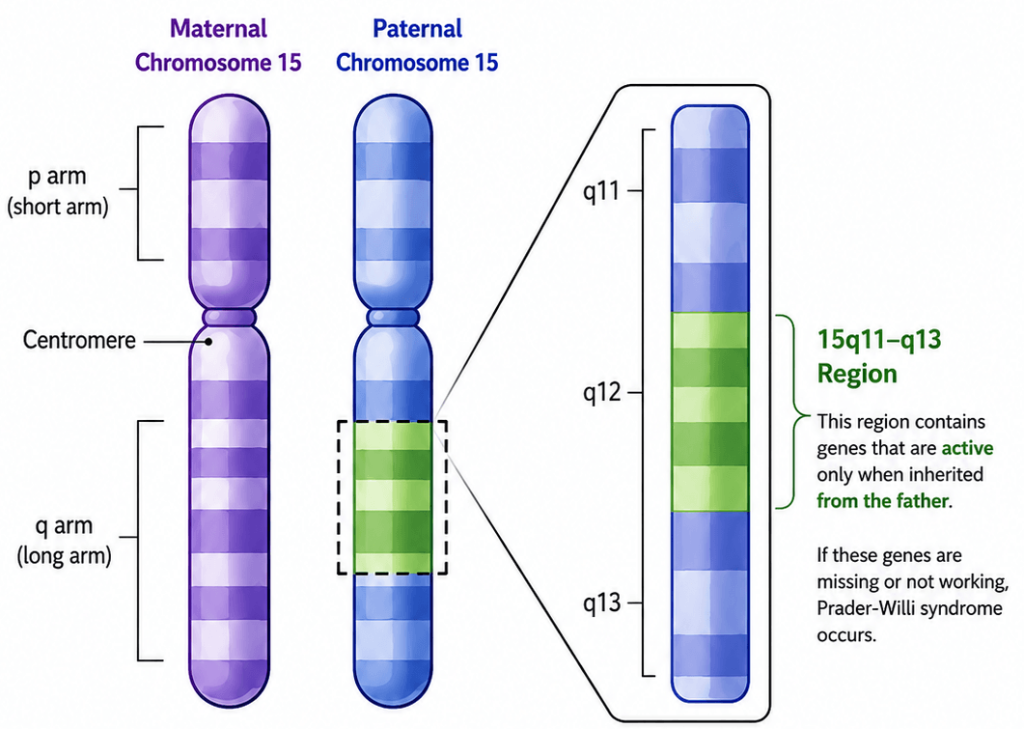
Her history of low muscle tone, delayed development, and feeding difficulties as an infant eventually leads doctors to perform genetic testing. Students then learn how changes in the 15q11–q13 region of chromosome 15 disrupt normal development of the hypothalamus, the brain’s control center for hunger and many other homeostatic functions.
Rather than memorizing vocabulary, students learn concepts through Ella’s experiences, helping them understand how genetics influences anatomy and physiology.
Connecting Multiple Biology Concepts
This case study naturally integrates several major topics commonly taught in high school Biology and Anatomy & Physiology courses, including:
- Genetics and genomic imprinting
- Chromosome structure and chromosome 15
- Homeostasis and hunger
- The hypothalamus and its role in regulating hunger
- The relationship between the nervous and endocrine systems
- Hormones involved in growth and appetite
- Medical genetics and genetic testing
- Treatments for the disorder
Related Resources
Classroom notes and slides on the senses – Access all resources for this unit, including concept maps
The Island of the Colorblind – Explore an island population where 1 out of 12 are colorblind due to genetic drift
Karyotype Activity and Chromosomes – Examine chromosome sets and determine which has trisomy or monosomy, and what disorders are associated with them
Investigation: Two-Point Discrimination Test – Use a compass and a ruler to test areas of the body for sensitivity
Giant Microbes Chromosome Plush – One of my favorite models to use with lessons related to chromosomes