

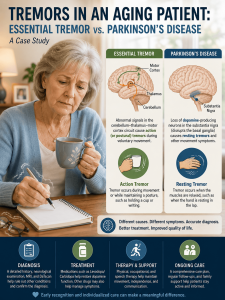
Many students have seen a grandparent, neighbor, or older family member whose hands shake while holding a cup of coffee, writing a note, or eating a meal. These tremors are often easy to notice, but understanding why they occur can be much more complicated.
This case study introduces students to June, a retired teacher who begins experiencing tremors that gradually interfere with her daily life. As her symptoms progress, students follow her journey through medical evaluations, neurological examinations, and diagnostic testing to determine whether her tremors are caused by Essential Tremor or Parkinson’s Disease.
Rather than simply memorizing definitions, students explore these disorders through the story of a realistic patient. Along the way, they learn how different regions of the brain contribute to movement and how changes in the nervous system can produce similar symptoms with very different underlying causes.
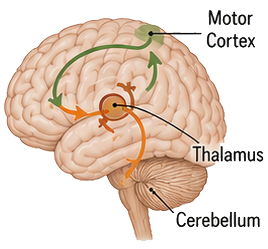
The case study examines the anatomy and physiology behind both conditions, including the role of the cerebellum, basal ganglia, substantia nigra, and the neurotransmitter dopamine. Students discover how physicians use clinical observations, imaging studies, and specialized tests to distinguish between disorders that may appear nearly identical at first glance.
Because many students know someone affected by tremors, the topic often creates an immediate personal connection. The case encourages students to think critically about symptoms, diagnosis, and treatment while building empathy for individuals living with neurological disorders.
Why Case Studies Work

One of the biggest challenges in teaching anatomy and health science is helping students connect complex biological concepts to real-life situations. While diagrams, vocabulary lists, and lectures are important, students often learn best when they can see how anatomy and physiology affect actual people. This is where case studies become powerful teaching tools.
Case studies place students in the role of investigators, encouraging them to examine symptoms, analyze evidence, and draw conclusions using scientific reasoning. Rather than simply memorizing the functions of the nervous system, students must apply their knowledge to understand why a patient is experiencing specific symptoms and how those symptoms relate to structures within the body.
This resource works well in biology, anatomy and physiology, health science, medical pathways, and neuroscience units. It can be used as an independent reading assignment, small-group discussion activity, sub plans, or as part of a unit on the nervous system. Discussion questions at the end of the case help reinforce key concepts and encourage students to analyze evidence much like a healthcare professional.
Related Resources
Anatomy Curriculum – Resources for teaching the brain and neurons
Case Study: Huntington’s Disease – explores symptoms, genetics, and inheritance patterns
Measles, Immunity and Vaccines – another case study exploring how a virus can cause life threatening brain inflammation
Investigation: Concussions – explores how repeated head injuries can result in CTE (chronic traumatic encephalopathy)
Human Brain Model – great for any unit on the nervous system