
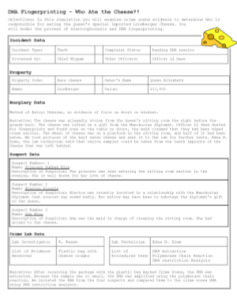
If you’re teaching genetics, biotechnology, or forensic science this year, try 🧀 “Who Ate the Cheese?” This is a student-friendly way to model gel electrophoresis and DNA fingerprinting without expensive lab equipment. This is great for freshman classes who are just learning about biotechnology (and maybe not ready to use expensive equipment.)
This activity puts students in the shoes of crime scene investigators. This simulation explores a whimsical scenario, the theft of Queen Elizabeth’s prized imported Limburger cheese. Students analyze DNA sequence strips from three suspects and a DNA sample from the crime scene. Their task? Use restriction enzyme cutting and electrophoresis simulation to determine who ate the cheese.
The scenario starts with an “incident report” that outlines the crime of the stolen cheese and a list of suspects. By running the fingerprint simulation, students discover who ate the cheese.
🧬Here’s how the simulation works:
- Cut DNA Strips – Students use scissors to cut paper DNA strands at specific restriction sites (e.g., CCGG). This models how real restriction enzymes cut DNA into fragments.
- Measure Fragments – They count base pairs on each fragment and annotate them, mirroring real lab measurements in base pairs (bp).
- Create a “Gel” Chart – Fragments are arranged by size from largest to smallest to simulate how DNA fragments separate in an electric field. Smaller fragments “move” farther than larger ones, just like in gel electrophoresis.
- Match the Pattern – Students compare the banding patterns from suspects to the crime scene sample to determine which suspect’s DNA matches.
This activity not only reinforces key concepts like restriction enzymes, polymerase chain reaction (PCR), and gel electrophoresis, but also helps students connect those concepts to real-world forensic applications.
The final page of the activity has a reading passage outlining the specifics of the biotechnology. Students answer questions from the passage and apply it to the activity. For instance, cutting the DNA represents the restriction enzymes. Moving the fragments by size represents how DNA moves in gel electrophoresis.
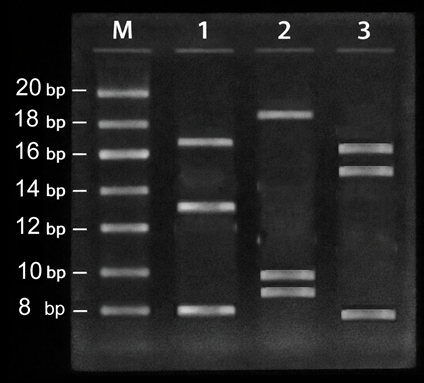
The image below shows a typical gel pattern that matches the paper model students will make.
Related Activities
Solving Crimes with Gel Electrophoresis – Students run gels using electrophoresis equipment to solve, uses Edvotek equipment and samples
Identifying Penguin Species with Restriction Enzymes – analyze samples and gel diagrams to identify penguin 🐧species
Darkow Online Simulation – Set the parents as either unaffected or affected for PKU, then run the gels to see which children are affected