
Looking for an engaging way to introduce students to DNA variation, inheritance, and genetic evidence? The Case of the Finch Flair is a classroom investigation that combines SNP analysis, pedigrees, and Punnett squares into a fun genetics mystery your students will enjoy solving.
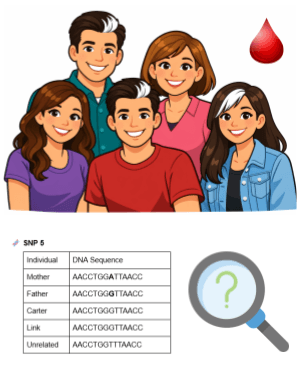
In this activity, students investigate whether a mysterious individual could be related to the Finch family. The Finch family has a distinctive trait, a white streak of hair known as the “Finch Flair.” This trait has appeared in multiple generations of the family, making it a perfect example for studying how traits are inherited.
A Genetics Mystery for Students to Solve
Students take on the role of genetic investigators. Their task is to examine multiple pieces of biological evidence to determine whether the mystery individual could truly be part of the Finch family.
The case includes several different types of genetic data that students must analyze:
DNA Evidence (SNP Analysis)
Students compare short DNA sequences containing single nucleotide polymorphisms (SNPs) between the unknown individual and several Finch family members. By examining where the DNA sequences match or differ, students determine whether the unknown individual shares genetic markers with the family.
Pedigree Analysis
Students analyze a family pedigree chart showing which members of the Finch family display the white hair streak. Using the pedigree, they identify patterns of inheritance and determine how the trait is passed through generations.
Punnett Square
The Finch Flair trait is treated as a dominant allele, allowing students to complete a Punnett square predicting the probability that offspring will inherit the trait. This helps reinforce the connection between genotype, phenotype, and inheritance patterns.
Skills Students Practice

This activity reinforces several key biology concepts and skills, including:
- Understanding single nucleotide polymorphisms (SNPs)
- Interpreting DNA evidence
- Analyzing pedigree charts
- Predicting inheritance using Punnett squares
- Using scientific evidence to support conclusions
Because the activity includes multiple types of genetic evidence, it works well as a case-study style investigation where students gather evidence and explain their reasoning.
Related Resources
Analyzing Pedigrees – basic pedigree practice showing single allele traits related to human genetic disorders
Advanced Pedigrees (AP Bio) – shows multiple types of inheritance in genetic disorders, including sex-linkage
Exploring Autosomal Dominant Traits – focus on polydactyly and and Marfan Syndrome
Dog SNPs and Curly Hair – modified HHMI exercise on mapping genes to traits in dogs