
Students often learn about biodiversity and taxonomy prior to learning the animal systems. We spend several days going over why animals need to be organized into groups. They learn about the taxonomic structure: Kingdom, Phylum, Class, Order, Family, Genus, Species. To help remember the list, a helpful mnemonic is: “King Philip Came Over For Great Soup.”
The slides I use with students also discuss why common names can be misleading, and how a scientific name is derived from the organism’s genus and species. For example, most bears belong to the genus “Ursus.” A polar bear’s scientific name is “Ursos arctos.”
We also discuss the concept of hybrid animals, like the mule and the liger. They are not considered their own species because the populations do not naturally interbreed and do not produce fertile offspring. We discuss the concept of wolves and dogs, and that dogs are considered a subspecies, with the scientific name: Canis lupus familiaris.
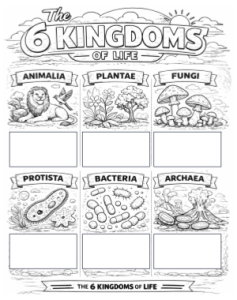
Finally, students learn about the six kingdoms and what organisms belong to which kingdom. Some are pretty obvious, like plants and animals. Others require a little extra explanation, like bacteria and archaea.
I created this little coloring worksheet to help students organize animals into the six kingdoms. They color (optional) the sheet and add three characteristics of each kingdom in the box. This is a nice break from a unit that doesn’t have a lot of hand-on activities!
The 6 Kingdoms of Life
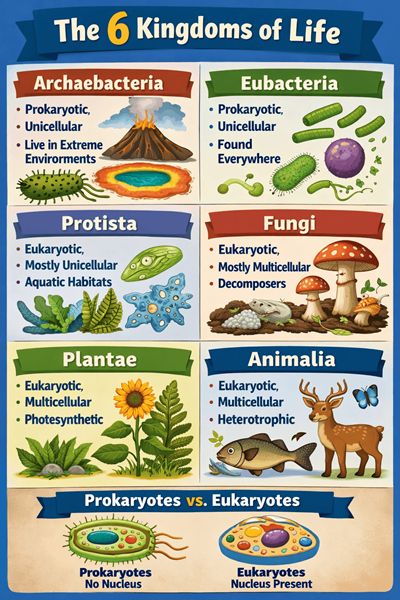
1. Archaebacteria (Archaea)
- Cell Type: Prokaryotic (no nucleus)
- Cell Number: Unicellular
- Cell Wall: No peptidoglycan
- Habitat: Extreme environments (hot springs, salt lakes, deep-sea vents)
- Nutrition: Autotroph or heterotroph
2. Eubacteria (Bacteria)
- Cell Type: Prokaryotic
- Cell Number: Unicellular
- Cell Wall: Contains peptidoglycan
- Habitat: Everywhere (soil, water, inside organisms)
- Nutrition: Autotroph or heterotroph
3. Protista (Protists)
- Cell Type: Eukaryotic (has a nucleus)
- Cell Number: Mostly unicellular (some multicellular)
- Cell Wall: Some have cell walls, some don’t
- Habitat: Mostly aquatic
- Nutrition: Autotroph or heterotroph
4. Fungi
- Cell Type: Eukaryotic
- Cell Number: Mostly multicellular (yeast is unicellular)
- Cell Wall: Made of chitin
- Habitat: Mostly land, damp environments
- Nutrition: Heterotroph (absorbs nutrients from decaying material
5. Plantae (Plants)
- Cell Type: Eukaryotic
- Cell Number: Multicellular
- Cell Wall: Made of cellulose
- Habitat: Mostly land
- Nutrition: Autotroph (photosynthesis)
6. Animalia (Animals)
- Cell Type: Eukaryotic
- Cell Number: Multicellular
- Cell Wall: None
- Habitat: Land, water, air
- Nutrition: Heterotroph (ingests food)
Related Documents
Slides: Ch 19 (Biodiversity and Cladograms)
Guided Notes – for students to fill in during the presentation
Cladogram Analysis – analyze a cladogram, identify derived characters, construct a cladogram
Phylogenetic Trees and Wolves – compare canids and analyze a phylogenetic tree