

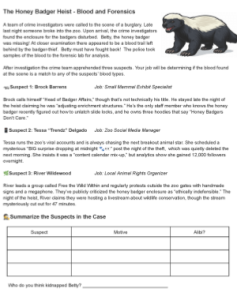
What happens when a honey badger goes missing and investigators find a mysterious blood sample at the scene? In this engaging, story-driven lab, students become forensic scientists tasked with solving the Honey Badger Kidnapping Case using simulated blood samples and ABO blood typing techniques.
This hands-on investigation blends biology, critical thinking, and just the right amount of zoo-themed chaos.
Simulated blood can be purchased from Carolina, though I have modified the story and suspects. I have also added questions and data collection for a streamlined lesson experience. The kits can be used more than once. I have 6 total, for each lab group.
🧪Lab Investigation: Determining Blood Types
In the investigation setup, students are introduced to four suspects connected to the zoo: the honey badger handler, the reptile enrichment consultant, the zoo’s social media manager, and a local animal rights activist. A small sample of “blood” collected at the scene becomes the key piece of evidence. Students receive simulated blood samples from each suspect along with anti-A, anti-B, and anti-Rh sera, blood typing trays, and mixing tools. Because all materials are synthetic, the lab remains completely safe while still mimicking real-world forensic procedures.
During the lab, students determine blood type by observing agglutination, or clumping, when blood is mixed with specific antisera. If clumping occurs with Anti-A serum, the blood is Type A; with Anti-B serum, it is Type B; with both, it is Type AB; and with neither, it is Type O. Clumping with Anti-Rh serum indicates Rh positive blood, while no reaction indicates Rh negative. After identifying the ABO and Rh type of each suspect, students compare the results to the crime scene sample to determine which individual cannot be ruled out.
🩸 Post-Lab Analysis: Thinking Like a Forensic Biologist

The post-lab analysis pushes students beyond simple identification. They explain why agglutination occurs by discussing antigens and antibodies, and they explore blood compatibility by determining which types can donate to or receive from others. Students analyze why Type O negative is considered the universal donor and why Type AB positive is considered the universal recipient.
By the end of the lab, students can confidently determine blood types using antigen-antibody reactions, explain compatibility rules, and understand the medical significance of blood transfusions. The honey badger storyline makes the experience memorable, but the deeper learning lies in connecting classroom biology to real-world forensic and medical applications. And while the fictional mystery may be solved by the end of class, the understanding of blood typing principles is what truly sticks.
Related Resources
The Science of Fingerprints – students learn how fingerprints are classified and used in forensic investigations
Forensic Lab on Blood Spatter – use artificial blood to explore explore a crime scene
The Mystery of the Bones – reconstruct (paper) skeletons to identify bodies found at a crime scene
Slides: Blood Typing and ABO Groups – Google slides with handout for students to learn about blood typing