
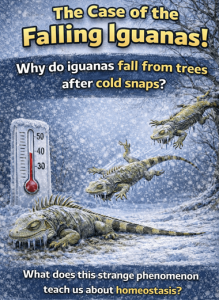
Engage your students with a real-world, biology-based phenomenon: Florida’s “raining iguanas.” During sudden cold snaps, iguanas lose muscle control and fall from trees, providing a dramatic example of ectothermy, torpor, and homeostasis. This case study combines observation, data interpretation, and critical thinking to help students connect behavior, physiology, and environmental influences.
Students can complete this activity on their own, which is perfect for a snow-day remote lesson. You can also add it to lessons on homeostasis and animal physiology. I would normally use this lesson in ecology units where we discuss invasive species. However, if the weather turns bad and we don’t have school, then it might be “Raining Iguanas.” If you don’t have a lizard in your classroom, a toy lizard might serve as a visual aid.
In this activity, students will:
- Analyze a temperature vs. activity graph highlighting the torpor zone (30–50°F).
- Compare ectotherm and endotherm strategies using a guided chart (iguana vs. squirrel).
- Complete fill-in-the-blank exercises reinforcing physiological concepts.
- Respond to CER (Claim–Evidence–Reasoning) prompts, using evidence from the graph, case study, and images.
Why Do Iguanas Fall From Trees?
Iguanas are ectotherms, meaning they rely on external heat sources to regulate their body temperature. In Florida’s typically warm climate, this strategy works well—until a sudden cold snap occurs. When temperatures drop into the 40s °F or below, iguanas experience a rapid slowdown in their metabolism.
As body temperature decreases, enzyme activity slows, and the muscles and nerves needed for movement and grip become less effective. Iguanas often sleep or rest in trees, and during cold conditions they may enter a state of torpor, a temporary, energy-conserving physiological response. In torpor, iguanas become stiff and immobile, losing their ability to cling to branches.
Because this change happens quickly, iguanas may lose their grip and fall from trees, creating the appearance that they are “raining” from the sky. Importantly, these iguanas are usually not dead. As temperatures rise, enzyme function and muscle control return, allowing many iguanas to recover and resume normal activity.
This phenomenon provides a powerful, real-world example of how environmental conditions directly influence physiology and behavior, and why ectothermic animals are especially vulnerable to sudden temperature changes.
Related Activities
How Do Mammals Maintain Their Temperature – data analysis, graph interpretation
Case Study – Tibetans and Altitude – explores genetic changes in populations living at high altitudes
HHMI Lizards in the Cold – graph analysis of anoles in Texas