
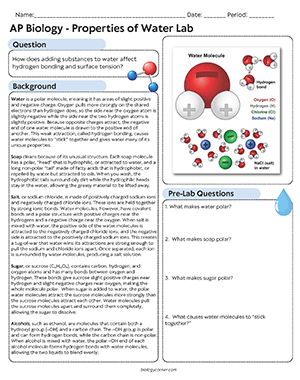
This investigation asks students to review the properties of water as they relate to life, usually a topic covered in the first or second chapter of most biology textbooks. Students then perform an experiment where they test the number of drops that can be placed on penny and compare that test to drops that contain soap, alcohol, salt, and sugar. Freshman students use a more basic version of this lab that does not incorporate statistical analysis.
For seniors, in Advanced Biology (AP), their task is much more complex. They don’t just compare soap, but also other solutes added to water. They also learn about the interactions of molecules, and how solutions have different properties.
In part one, students read background information on polarity and how different materials (like soap) can affect those bonds, making water less “sticky.” When they count the number of water drops that fit on a penny, the soapy water will result in much fewer drops. Alcohol, salt, and sugar with also reduce the cohesiveness of water, but it will not be as dramatic as the soap.
I use this lab to illustrate water properties, but also to give students a basic introduction to using spreadsheets to analyze data and create a graph. The handout includes detailed instructions on how to set up the Google Sheet, and how to use functions to calculate standard deviation and standard error. In prior lessons, students have learned how to do these calculations by hand. They quickly realize how much easier it is to do it on a spreadsheet rather than having to tackle the equation with a calculator. Though, to be fair, the steps involved in creating the graph can be daunting. You can access my spreadsheet (with sample data) here.
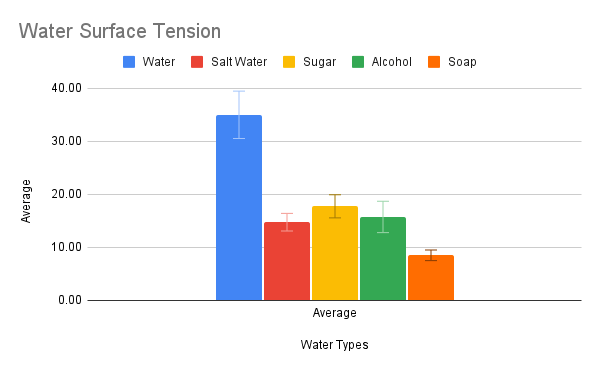
Finally, students use scientific reasoning to explain how soap affects hydrogen bonds using terms such as cohesion, surface tension and polarity. They will upload their CER with their graphs to Google classroom. Basically, students should be able to explain that soap (and other solutes) weaken hydrogen bonds, which means that less water will fit on the penny. Evidence would include references to hydrogen bonds, and how solutes affect those bonds.
The most recent version of this lab is hosted on Canva. You can use the Canva template to make edits or print directly from the app.
Grade Level: 11-12 (AP Biology)
Time Required: 45-60 minutes