
Category: Worksheets
-

Practice Genetics: Sex Linked Genes
Students learn basic Mendelian genetics by crossing traits from fruit flies and pea plants. In this extension, students can practice doing crosses that involve sex-linked traits, where the alleles are located on the X chromosome which affects the pattern of inheritance. This worksheet is designed for beginning biology students, as it provides in most…
-
The Anatomy of the Kidney and Nephron
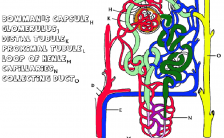
This coloring worksheet asks students to color the kidney to identify where structures like the medulla, cortex, renal vessels and ureters are located. Another image focuses on an individual nephron to identify the glomerulus, proximal and distal tubules, and the Loop of Henle. This worksheet is intended for advanced students of anatomy. Students will…
-
Modeling Independent Assortment & Dihybrid Crosses
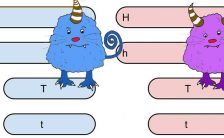
Students examine how two traits are inherited, revealing that each allele has an equal chance of being passed on to the next generation, the principle of independent assortment.
-
Compare a Human and Chimpanzee Skeleton
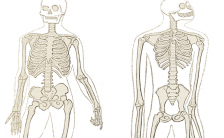
This handout can be used in discussions on the evolution of bipedalism or in any unit on the skeletal system. Students label the bones of the skeleton and make comparisons between the forelimbs, hind limbs, and pelvis. I created this handout to compliment an evolutionary lesson and video from HHMI on the “Origin of Humans”…
-

Investigation: Modeling Heredity with Popsicle Sticks
In this activity, you will use popsicle sticks to model the process of gamete formation and the combining of sperm and egg to create offspring. Results of the simulation can then be compared to Punnet square expected results. Popsicles should be made in advance, the set contains a male and female set with the genotypes…
-
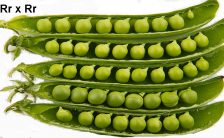
Simple Mendelian Genetics Practice Problems
Students learning basic Mendelian genetics can practice assigning genotypes and identifying heterozygous and homozygous configurations. Squares are set up to do crosses with purple and white flowers as seen in Mendel’s pea plants. The worksheet is very simple, designed for beginning students of biology and genetics. More difficult versions of genetics practice problems might…
-
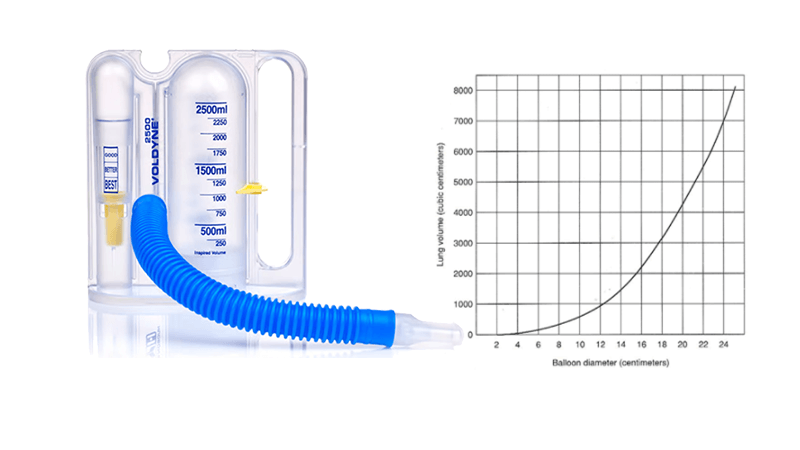
Investigation: What Factors Affect Lung Capacity
In this investigation, students use balloons and rulers to estimate the vital capacity of lungs using test subjects within the class. To perform the test, subjects take a deep breath and blow into a balloon. The diameter is measured and a graph is used to estimate the volume of air expelled based on the diameter…
-
How to Learn the 12 Cranial Nerves
Learn the 12 cranial nerves with this simple mnemonic and coloring worksheet, appropriate for high school anatomy students.
-
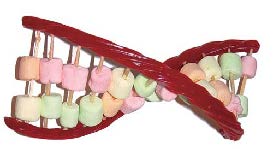
Construct a DNA Model Using Marshmallows
Use marshmallows and toothpicks to construct a model of DNA. Mini marshmallows represents the nucleotides, large marshmallows represent deoxyribose.
-

Case Study: Why Are There No Male Calico Cats?
This presentation case study asks two important questions regarding cat coloration: The case is presented as a slide presentation where students consider evidence and data related to cat coloration and chromosomes. Working in small groups, they discuss the case and eventually answer the two main questions. I usually collect their answers at the end of class…
-
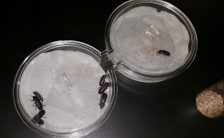
Investigation: Habitat Selection in Flour Beetles
This activity was modified from an Advanced Placement Investigation for use with freshman classes. The instructions are clear and require students to examine data and create a graph. Then students collect their own data using Choice Chambers and can choose which variables they would like to test: wet vs dry, water vs vinegar, light…
-
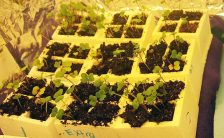
Inquiry in Genetics Using Wisconsin Fast Plants
Genetic Experiments can be intimidating for teachers due to the time and cost of breeding plants or animals in a classroom. These issues are further complicated in a public school setting which may have space issues, limited funds, and lack of access to labs. My favorite model for genetic experiments is the Wisconsin Fast…
-
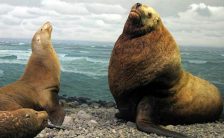
Meiosis Case: SRY not SRY
Students are given a scenario about a female athlete who was stripped of her medal when it was discovered that her cells contain a Y chromosome.
-
Zoobiquity – Review and Discussion Questions
I try to read at least one non-fiction book per year to try to keep myself up to date and inspired with new knowledge and advances in medicine. I have a classroom set of “Stiff” that I require my AP Biology students to read during the unit on anatomy. Recently, in a graduate class…
-
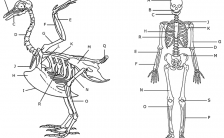
Comparing a Human and Avian Skeleton
Students often learn the bones of a human skeleton in health, but biology class can reinforce these lessons by comparing the human skeleton to that of other vertebrates. In this case, students color the skeleton of a bird and a human according to the directions. The colors will illustrate how many of the bones…