
Most biology classes begin with defining life and the scientific method. Why not explore both with this case study where students explore case where scientists determine whether a microscopic substance qualifies as a life form. In the Openstax Biology 2e textbook, the first chapter deals with the scientific method, characteristics of life, and branches of biology, like forensics. You can find all of my resources for this unit at biologycorner.com/APBiology.
In this case study, students read details about the substance known as nanobacteria. The details are from a real study published by PNAS. I have adapted it for high school students, including making sections and questions to answer as students interact with high level science text. They will find that some characteristics seem consistent with life. Other traits suggest that the substance is not alive. Ultimately, students make a judgment based on the evidence. They use reasoning to make the case whether nanobacteria is a life form or not.
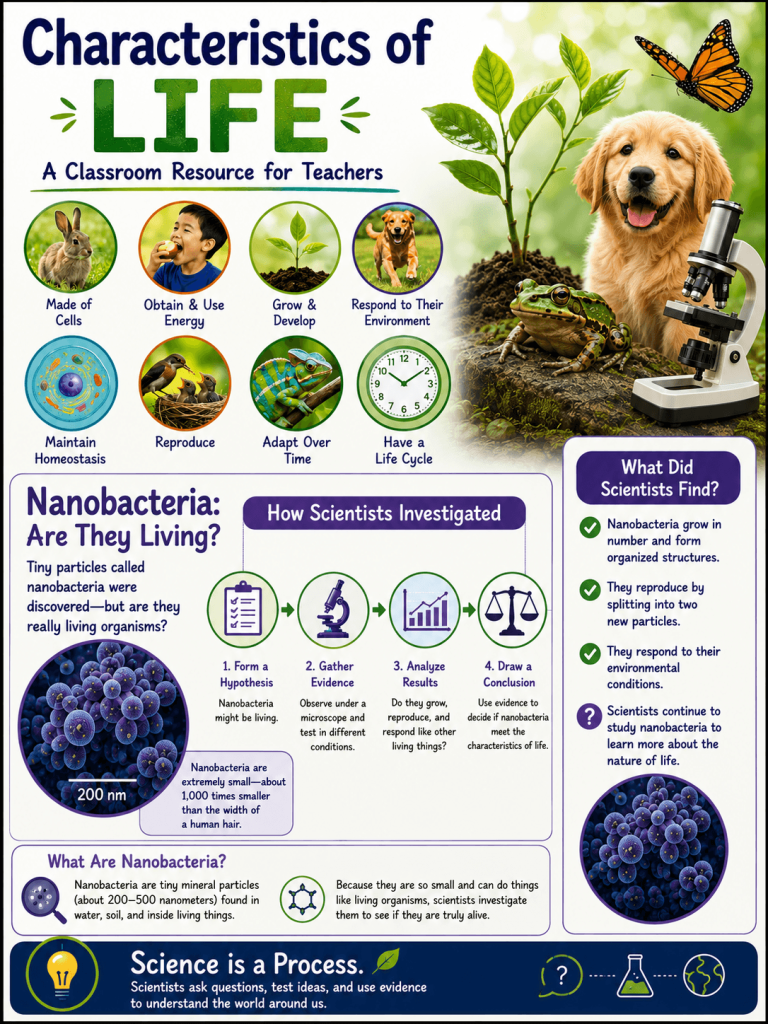
What Are Nanobacteria?
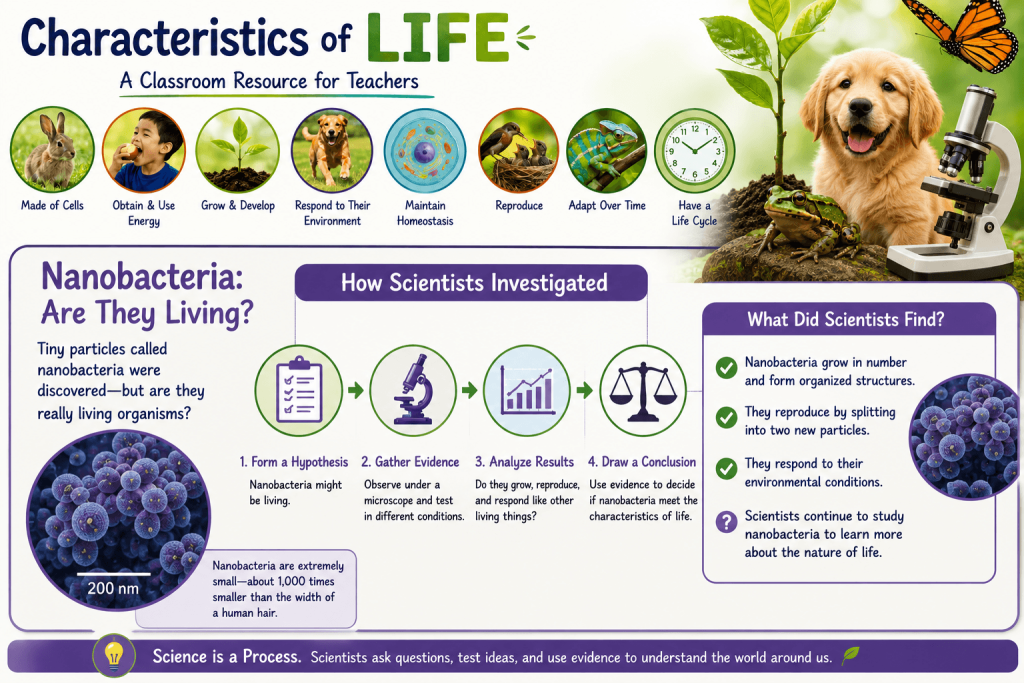
Nanobacteria is the name given to a proposed class of living organisms. Whether these structures represent life is a matter of some controversy. In this case study, students review the evidence of scientists on both sides of the controversy. First, they list properties of life as given in their textbook. These include:
- Cells
- Reproduction
- DNA
- Growth and Development
- Energy Use
- Response to environment
- Homeostasis
Note: Biology textbooks usually start with a list of life characteristics, but the list can vary from text to text.
The Nanobacteria Case
Students work in small groups to understand what the observations and data mean. Some properties are questionable. For example, the nanobacteria do seem to grow. By itself growth may not be enough to qualify. Other nonliving things appear to grow, like crystals.
Another questionable observation is the presence of DNA. One group of scientists attribute the DNA to the nanobacteria. Another group suggests that the DNA is from a separate bacterial contaminant.
The project ends with students writing an individual essay stating whether they believe the evidence is compelling enough to claim that nanobacteria are indeed living organisms. They present a final essay in CER (claim, evidence, reasoning) format.
This is a good case to introduce in the first chapter/unit where students are given the typical list of traits that are found in living organisms. They also are introduced to the scientific method, where gathering data and observations are critical to determining the nature of life (or non-life).
Spoiler: Ultimately scientists in this study, and in later studies conclude that nanobacteria do not mee the criteria to qualify as a life form.
Grade Level: 11-12 (AP Biology)
Time Required: 2-3 hours
HS-LS1-2 Develop and use a model to illustrate the hierarchical organization of interacting systems that provide specific functions within multicellular organisms