
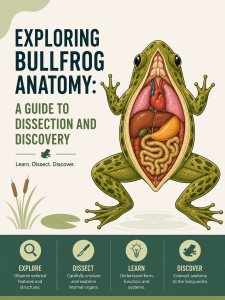
Dissections have long been a cornerstone of biology education because they provide students with a unique opportunity to explore the structure and function of living organisms in a hands-on way. While diagrams and models are valuable learning tools, nothing compares to observing actual organs, tissues, and body systems as they are arranged within an organism. This Bullfrog Dissection Worksheet and Lab Guide helps students investigate the anatomy of a vertebrate while developing important scientific observation and laboratory skills.
I designed this lab to be more in-depth than the frog dissection I use with my freshman class. AP Bio students will also focus on the circulatory system and the nervous system. I order my frogs from Carolina and get them single injected for better viewing of the arteries.
This lab will take 3-4 days, so plan to store your frogs in large freezer bags. I also place them in plastic bins to reduce the smell.
Why Study the Bullfrog?
The bullfrog is an excellent model organism for studying anatomy because it shares many characteristics with other vertebrates, including humans. Although frogs are amphibians, they have many of the same organ systems found in mammals.. By examining these structures firsthand, students gain a deeper understanding of how body systems interact to maintain homeostasis, the stable internal conditions necessary for life.
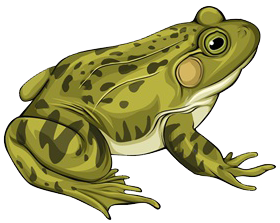
In addition, frogs occupy both aquatic and terrestrial environments during their life cycle, making them ideal for studying adaptations that support life in different habitats. Students can observe features such as moist skin used for respiration, powerful hind limbs adapted for jumping and swimming, and specialized sensory structures that help frogs survive in the wild.
Students will:
- Identify major external structures, including the tympanic membrane, nostrils, eyes, and dorsolateral folds.
- Examine the muscular system by exposing leg muscles and observing the Achilles tendon and sciatic nerve.
- Investigate the circulatory system by locating the heart and tracing arteries branching from the conus arteriosus.
- Explore the digestive system, including the liver, gallbladder, stomach, pancreas, and intestines.
- Examine the urogenital system and distinguish between male and female specimens.
- Expose and identify major regions of the brain and nervous system.
- Analyze how body systems work together to support movement, respiration, digestion, reproduction, and homeostasis.
Related Resources
Frog External and Internal Images – shows labeling for many of the frog images in the freshman and AP Bio frog dissection packets
Fetal Pig Dissection Guide – lab guide for the fetal pig dissection
The Case of the Fanged Frog – learn about cryptic species and speciation with this mini case study on the fanged frog
Frog Specimens available on Amazon