
Inspired by the ongoing 2026 Cyclospora outbreaks linked to contaminated fresh produce.
Foodborne illnesses often make headlines, but students rarely get the opportunity to explore the biology behind these outbreaks. This Cyclospora Case Study uses a current food safety event to help students connect microbiology, anatomy, physiology, and public health through the story of a college student who develops severe gastrointestinal symptoms after eating a restaurant salad.
Instead of memorizing facts about parasites, students become medical investigators. They follow Ryan, a healthy young man whose seemingly harmless meal leads to days of explosive diarrhea, dehydration, and a trip to the doctor’s office. As students work through the case, they learn how physicians identify the cause of his illness and why a microscopic parasite can have such dramatic effects on the digestive system.
Cyclospora outbreaks linked to fresh produce continue to appear in the news, making this case study especially relevant. Students quickly realize that foodborne illnesses are not just historical examples, they are real public health concerns that affect thousands of people every year.
Using an authentic scenario increases student engagement while reinforcing that biology directly impacts everyday life.
Connecting Microbiology to Human Anatomy

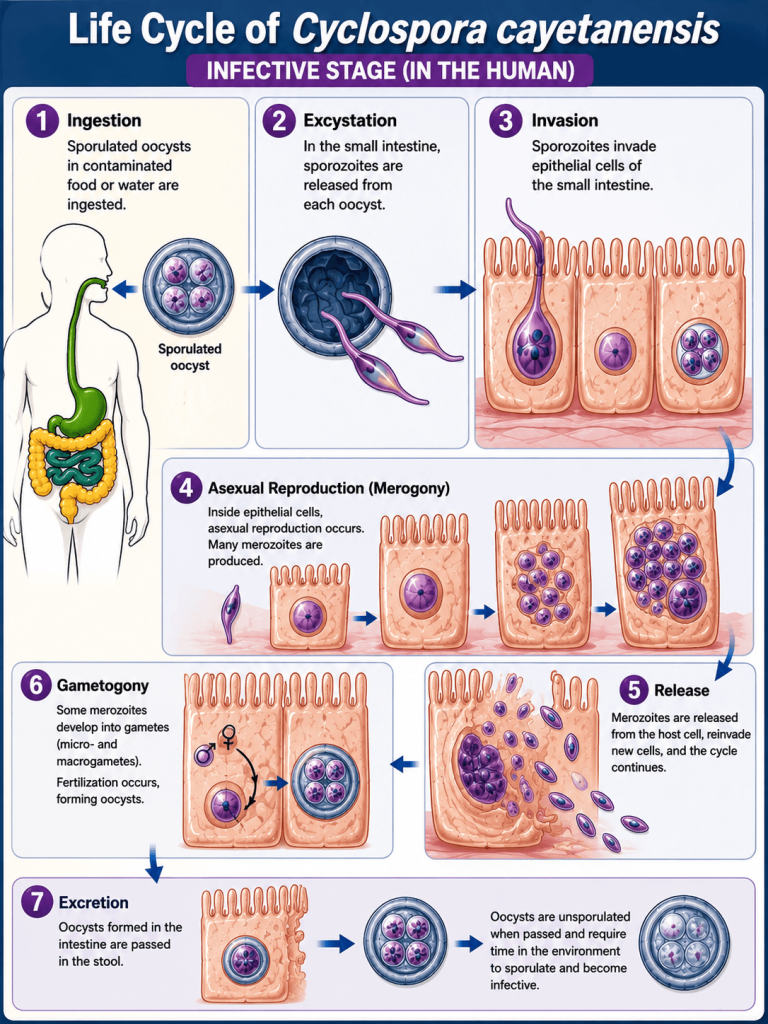
One of the strengths of this activity is the emphasis on anatomy and physiology. Students investigate how it invades the epithelial cells of the small intestine and how this affects the homeostasis of the patient, leading to watery explosive diarrhea.
Students also analyze realistic patient information, including vital signs. Ryan’s elevated heart rate, low blood pressure, and abnormal electrolyte values provide evidence of dehydration caused by prolonged diarrhea.
In the second section, students read the laboratory test results revealing that Ryan has been infected with a protozoan parasite, Cyclospora. The learn how the pathogen disrupts the normal activity of the small intestine by damaging villi responsible for absorption. Students discover why damage to the intestinal lining results in watery diarrhea, dehydration, weight loss, and electrolyte imbalances. Without treatment, that parasite will continue to reproduce and infect new cells of the digestive tract.
The case ends with Ryan’s treatment plan, which includes a course of antibiotics and drinking fluids to replace electrolytes. Ryan should have a full recovery!
The resource includes full-color graphics illustrating how Cyclospora infects the small intestine. Students can follow the parasite from ingestion to invasion of intestinal epithelial cells, replication inside the host, and the resulting damage to the digestive tract. These illustrations make a microscopic process much easier to understand while supporting visual learners.
Each section has related questions and graphic analysis, and students complete a final CER that summarizes the main points of the case with regard to what caused Ryan’s diarrhea.
Related Resources
Notes and Resources on the Digestive System – worksheets and activities I use in my anatomy class
Exploring the Immune System with Alpha – Gal Syndrome – a bite from a tick causes a mysterious meat allergy (case study)
Case Study: The Placenta, MS, and a Viral Past – explores possible causes of multiple sclerosis
How Does the Height of Villi Affect Nutrient Absorption – simulation explores how changing villi affect digestion
Collector Pans for Stool Samples – show students how a fecal sample is taken at home or in hospitals