
When students think about the human body, they often focus on organs like the heart, lungs, or brain. Yet the body’s largest organ is something they see every day—the skin. Despite its importance, students frequently underestimate the complexity of the integumentary system and the many structures working beneath the surface.
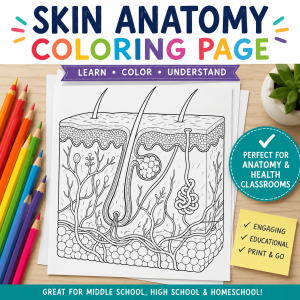
This Skin Anatomy Coloring Page helps students explore the anatomy of the skin through a hands-on activity that combines visual learning, reading comprehension, and critical thinking.
The skin serves as the body’s first line of defense against injury, pathogens, and environmental hazards. It helps regulate body temperature, prevents water loss, produces vitamin D, and provides sensory information about the world around us.
Understanding the structure of the skin gives students a foundation for learning about homeostasis, human anatomy, and the body’s response to environmental changes.
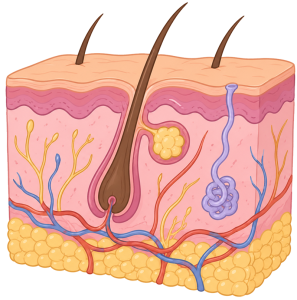
This resource introduces students to key structures found within a cross-section of the skin, including the epidermis, dermis, hypodermis, hair follicles, sweat glands, oil glands, blood vessels, and sensory nerves.
Connecting Structure and Function
One of the biggest challenges in anatomy is helping students understand that form and function are closely linked. This activity goes beyond identification by including descriptions and questions that encourage students to think about why each structure exists.
For example, students learn how:
- Sweat glands help regulate body temperature.
- Blood vessels transport oxygen and nutrients while assisting with heat regulation.
- Sebaceous glands produce oils that protect the skin and hair.
- Nerves detect touch, temperature, and pain.
- Fatty tissue cushions the body and provides insulation.
By exploring these functions, students gain a deeper appreciation for how the skin contributes to maintaining homeostasis.
Addressing Common Misconceptions
The integumentary system is also a great opportunity to discuss common myths and everyday experiences. Questions such as “Does shaving make hair grow back thicker?” or “Why do we sweat when we’re hot?” help students connect anatomy to their own lives.
These real-world connections make the material more relevant and memorable while encouraging scientific thinking.
Related Resources
What Causes Goosebumps – Anatomy of the Skin – diagram with skin anatomy and a focus on why animals (and humans) get goosebumps
Case Study – How Do Genes Determine Skin Color? – a close look at skin color and polygenic inheritance
Investigation – Two Point Discrimination Test – use a mathematical compass to test the sensitivity of different areas of the body (palm, wrist, cheek, etc)
3D Model of the Skin – keep models in the classroom for students to get a more in-depth view