
Teaching DNA damage and repair can feel abstract for students, until they can clearly visualize and apply it. This classroom-ready activity helps students understand thymine dimers and nucleotide excision repair (NER) through diagram analysis, structured questions, and real-world connections. By focusing on how DNA is damaged by UV radiation and how cells fix that damage, students build a deeper understanding of molecular biology concepts that directly connect to human health.
🌞 Why Teach Thymine Dimers?
Students are often familiar with DNA structure, but less so with what happens when DNA is damaged. Ultraviolet (UV) radiation from sunlight can cause adjacent thymine bases to bond together, forming a thymine dimer. This disrupts the DNA double helix, blocking replication and transcription. If left unrepaired, it can lead to mutations and even skin cancer.
This topic naturally connects to:
- Cell cycle and DNA replication
- Mutations and evolution
- Human health and disease
What’s In the Activity
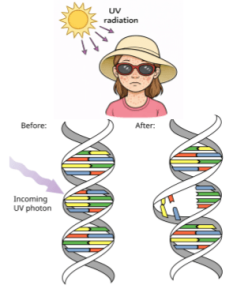
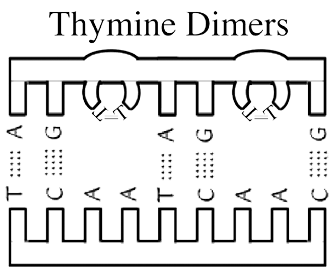
In the first part of the exercise, a graphic shows how incoming UV radiation damages DNA. A thymine dimer occurs when two adjacent thymine baes link together. This causes a distortion of the double helix that disrupts replication and translation.
Fortunately, cells have mechanisms for repairing these dimers. In nucleotide excision repair (NER), the damaged DNA is cut and then replaced using DNA polymerase. In the second section, a graphic shows this repair mechanism. This also includes a short section on another repair mechanism that uses light energy, direct repair, which uses light energy to break the abnormal bonds between the thymine bases.
Finally, students explore a real-world connection to a condition called xeroderma pigmentosum. This genetic condition occurs when a person has a mutation in the NER genes. Their cells cannot repair the thymine dimers, which can lead to severe DNA damage and skin cancer at a young age.
CER Writing Task
Students apply their understanding through a Claim–Evidence–Reasoning (CER) prompt comparing normal cells to cells that cannot repair thymine dimers. This builds:
- Scientific argumentation skills
- Use of academic vocabulary
- Cause-and-effect reasoning
The answer key to the activity can be purchased at TpT, which also includes a rubric and sample response for the CER.
Related Resources
DNA Slides with Guided Notes (AP Biology) – slides I use with my class and student handout
Label the Steps of DNA Replication – shows the leading and lagging strand with enzymes needed in the process (helicase, polymerase, ligase)
DNA Mutations Activity – use a simulation to show how changes in DNA affect the protein
DNA, Proteins, and Mutations – explore how a single change in DNA can alter a protein like insulin; use codon chart to show changes in amino acids
Giant Microbes DNA plush – I use this toy frequently to help students visualize the structure of DNA