
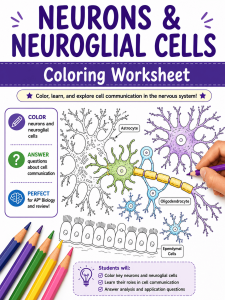
Students can practice what they have learned about neurons with this simple coloring activity. The page shows features of the neuron, such as the axons and dendrites. They will also color the supporting cells of the matrix.
There are no instructions, students must identify each of the types of glial cells: oligodendrocytes, astrocytes, microglial cells, , and ependymal cells. They should use their textbook or other resources to identify the cells and color them according to the directions. You can also display a large image of the neuron on the projector to help them identify parts.
Several images of the neuroglia can be found online to help students complete this assignment if there are no applicable images in their textbook.
After coloring the diagram, students write a brief description about each of the neuroglia. This is information that can be found in the notes from the chapter.
Resource updated June, 2026.
Neuroglial Cells
Neuroglial cells, or glial cells, are specialized support cells of the nervous system. Unlike neurons, glial cells do not transmit nerve impulses. Instead, they protect, nourish, and support neurons, helping them function efficiently.
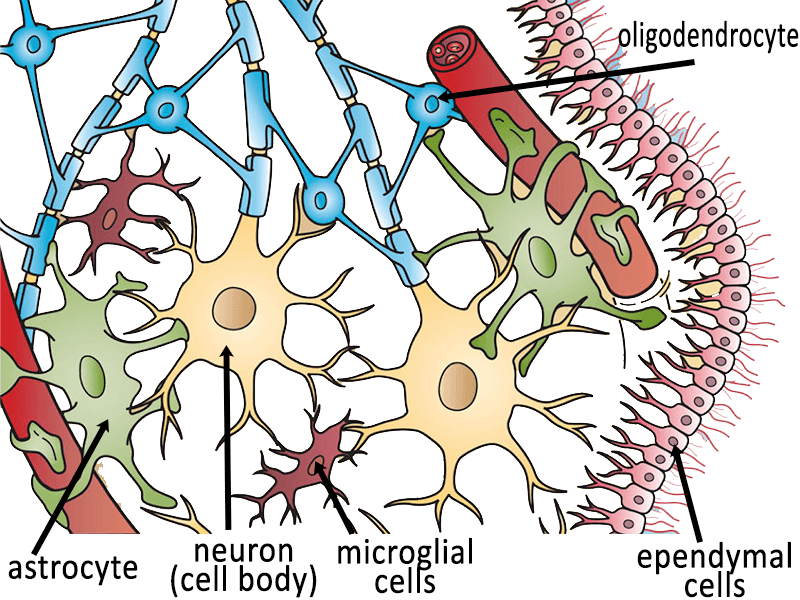
Astrocytes are star-shaped cells that provide structural support, regulate the chemical environment around neurons, and help form the blood-brain barrier.
Oligodendrocytes produce the myelin sheath that insulates axons in the central nervous system, allowing nerve impulses to travel more quickly.
Microglia act as the immune cells of the nervous system. They remove pathogens, damaged cells, and cellular debris through phagocytosis.
Ependymal cells line the ventricles of the brain and the central canal of the spinal cord. They help produce and circulate cerebrospinal fluid (CSF), which cushions and protects the central nervous system.
Together, neuroglial cells maintain a healthy environment for neurons and play essential roles in communication, protection, and repair within the nervous system.
Related Documents
Nervous System Slides and Guided Notes – for classroom use
Label the Structures of a Neuron and Neuroglial Cells – more practice identifying cells of the matrix
Case Study: Fading Memories – worksheet exploring how Alzheimer’s disease affects the brain and neurons
Case Study: Neurons and Cell Communication – focus on multiple sclerosis and how neurons are affected
Neuron Plush Toy – one of my favorite plushies to show to students during the nervous system unit.