
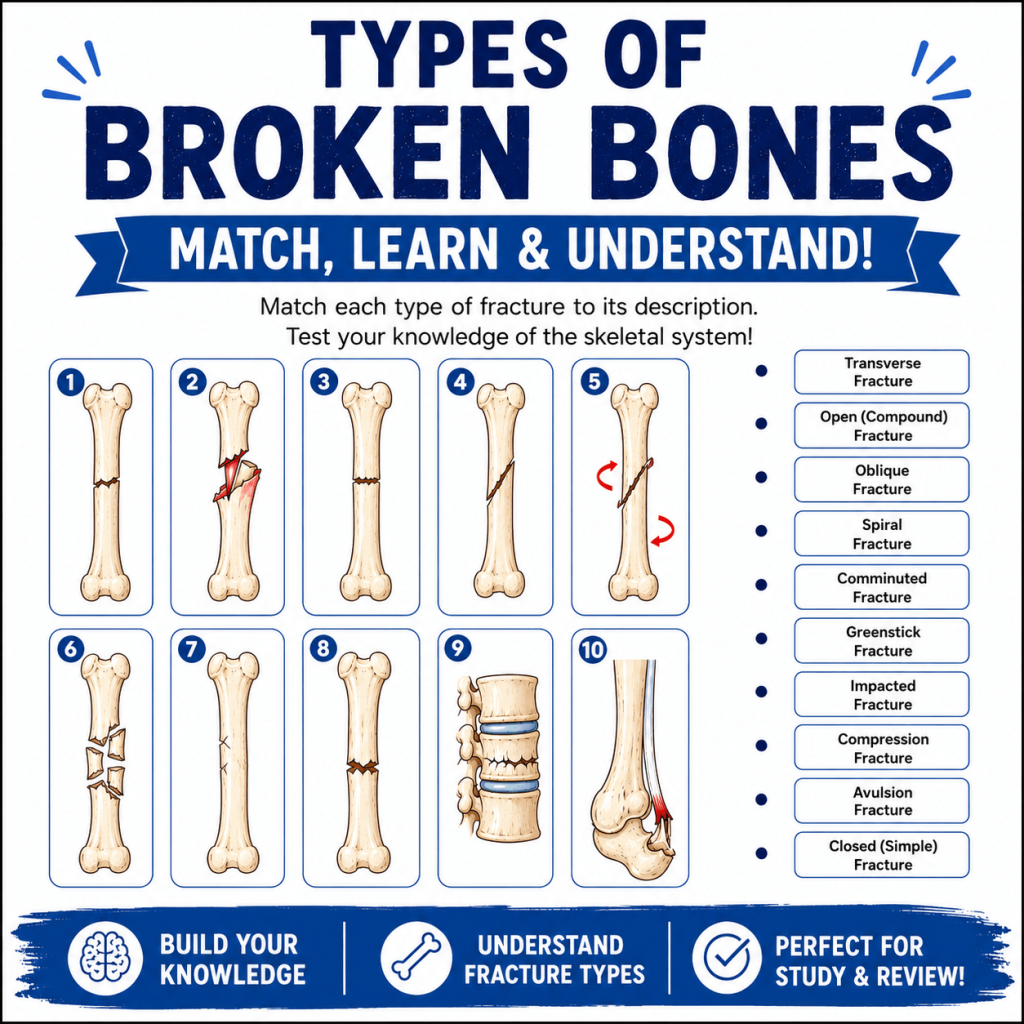
A broken bone might sound simple, but fractures can occur in many different ways. Some bones crack straight across, others break at an angle, and some may even shatter into several pieces. In this bone fracture matching activity, students explore the different types of fractures by examining graphics and matching each image to a written description.
This activity is a simple way to add visual learning to a unit on the skeletal system. Instead of memorizing a list of fracture terms, students must carefully examine the shape and location of each break and use the descriptions to identify the fracture type.
How the Fracture Matching Activity Works
Students are shown a series of illustrations representing different types of broken bones. Each fracture is numbered. Students then read short descriptions of the fractures and match each description to the correct image.
The activity encourages students to look for visual clues. Is the break straight across the bone? Does it occur at an angle? Has the bone shattered into several pieces? Is a small piece of bone being pulled away by a tendon or ligament?
These details help students connect anatomy vocabulary with an actual visual representation of the injury.
Types of Bone Fractures Included
Closed (Simple) Fracture: A closed fracture occurs when a bone breaks but does not pierce through the skin. The skin remains intact even though the bone underneath is damaged.
Open (Compound) Fracture: An open fracture occurs when a broken bone breaks through the skin and creates an open wound. These fractures have an increased risk of infection.
Transverse Fracture: A transverse fracture forms a break that runs straight across the bone. It is often caused by a strong force applied directly to the bone.
Oblique Fracture: An oblique fracture occurs at a diagonal angle across the bone. The slanted fracture line distinguishes it from a transverse fracture.
Spiral Fracture: A spiral fracture wraps around the bone in a twisting pattern. This type of break is usually caused by a rotational or twisting force.
Comminuted Fracture: A comminuted fracture occurs when a bone breaks into three or more pieces. These fractures are often associated with high-impact injuries.
Greenstick Fracture: A greenstick fracture is an incomplete break in which one side of the bone cracks while the other side bends. Because children’s bones are more flexible, greenstick fractures are more common in younger individuals.
Impacted Fracture: An impacted fracture occurs when one broken end of a bone is pushed into the other. Compression forces are often responsible for this type of injury.
Compression Fracture: A compression fracture occurs when a bone is crushed or collapses under pressure. These fractures are commonly seen in the vertebrae of the spine.
Avulsion Fracture: An avulsion fracture occurs when a tendon or ligament pulls a small piece of bone away from the main bone. These injuries often occur near joints and may result from sudden or forceful movements.
Related Resources
Slides and Student Notes for the Skeletal System – students complete a guided notes packet with labeling activities that go with the slide presentation
Color the Bone Matrix – focus on the microscopic organization of bones, showing the lacunae, osteocytes, Haversian canals, Volkmann’s canals, and canaliculi
Anatomy of a Long Bone – coloring activity showing the features of bone: spongy bone, compact bone, diaphysis, epiphysis, articular cartilage, medullary cavity, bone marrow, and periosteum