
Teaching acids and bases can be challenging because many of the concepts are invisible. Students can’t see hydrogen ions, hydroxide ions, or the chemical reactions happening in a solution. That’s why visual learning tools are so valuable. Acidity and alkalinity are usually covered in chemistry, which is a prerequisite for AP biology, but students will usually need a refresher. They will be working with these types of chemicals in the lab, so revisiting safety is important.
One of my favorite demonstrations is the bromothymol blue test. Place a diluted solution of BTB in an Erlenmeyer flask. Don safety goggles to demonstrate proper lab procedure, and then use a straw to blow bubbles into the solution. Your breath is slightly acidic, and it will turn the blue color of the solution into yellow!
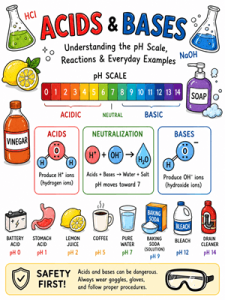
This Acids and Bases Coloring Worksheet helps students visualize the pH scale, understand water dissociation, and learn how acids and bases interact. (This is an update of an older acids and bases worksheet.) I also do a quick lab with pH paper, where students explore the pH of different household substances, like bleach and vinegar. Students can do the coloring worksheet and the mini-lab at the same time!
Understanding the pH Scale
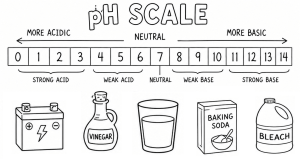
The pH scale ranges from 0 to 14 and measures how acidic or basic a solution is.
Students learn that:
- Acids have a pH below 7.
- Neutral substances have a pH of 7.
- Bases have a pH above 7.
The worksheet includes common examples that students encounter every day, such as lemon juice, vinegar, coffee, baking soda, soap, and bleach. By connecting pH values to familiar substances, students develop a stronger understanding of how the scale works.
Water Dissociation: The Foundation of pH
One of the most important concepts in understanding acids and bases is the idea that water naturally dissociates into ions.
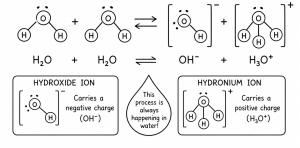
Although most water molecules remain intact, a small number continuously separate according to the following reaction:
2H₂O ⇌ H₃O⁺ + OH⁻
This process creates:
- Hydronium ions (H₃O⁺), which contribute to acidity
- Hydroxide ions (OH⁻), which contribute to basicity
Because pure water contains equal amounts of hydronium and hydroxide ions, it has a neutral pH of 7.
The coloring worksheet includes a visual diagram showing water molecules separating into hydronium and hydroxide ions, helping students understand where these ions come from in the first place.
What Students Will Learn
This resource introduces students to several foundational chemistry concepts:
- The pH scale and what it measures
- The difference between acids and bases
- Hydrogen ions (H⁺) and hydroxide ions (OH⁻)
- Water dissociation
- Acid and base dissociation
- Neutralization reactions
- Laboratory safety when handling acids and bases
The worksheet uses diagrams, illustrations, and coloring activities to help students connect abstract chemistry concepts with real-world examples.
Related Resources
AP Biology Curriculum Resources – includes all of the units and resources I use with AP Bio
pH Scale – PHET interactive – explore how different solutions affect pH
Lab: Properties of Water – explores cohesion and adhesion; graphing with stats (AP Bio)
Water Strider Lab – investigate surface tension by finding how many drops fit on penny (Reg Bio)