
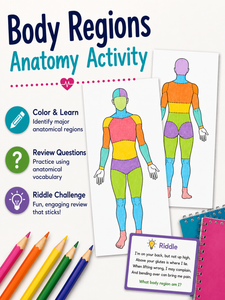
Learning anatomical terminology is one of the first challenges students encounter in an anatomy class. Before students can describe the location of a bone or organ, they need a common language for identifying areas of the body. This Body Regions Anatomy Activity gives students a visual and approachable way to learn these important terms.
Rather than relying on memorization alone, this activity uses diagrams to help students connect each term to its location. Students work with both anterior (front) and posterior or dorsal (back) views of the human body.
The anterior diagram introduces regions such as the frontal (forehead), orbital (eye), and the pectoral (chest). The image shows multiple regions on both a dorsal side image, and a ventral side image. Having students locate and shade a region requires them to spend more time examining its position and boundaries. For example, visually distinguish the thoracic region from the lumbar region or compare the femoral region with the popliteal region.
Color the Anatomical Body Regions
Students use a page describing each region and indicated by letter on the diagram. This is the easy part, they just need to find the letter and color according to the key. Next, they will need to label each region. This part is more difficult, but provides the necessary reinforcement for learning the names of each region.
The diagrams can also be reused later as a review. Cover the labels and project the figure for the class, then ask students to identify the anatomical region. You could also turn this into a quick bell-ringer by choosing three or four regions for students to identify each day.
Anatomical regions may seem like a simple vocabulary lesson, but these terms provide an important foundation for everything students will study later. Describing structures as being in the cervical, thoracic, abdominal, pelvic, or femoral region is much more precise than simply saying something is near the neck, back, stomach, or leg. For fun, I will do a “Simon Says” game at the beginning of class.
Once students become comfortable with regional terminology, it’s easier to introduce other foundational concepts such as anatomical position, directional terms, body planes, and body cavities.
Combining diagrams, coloring, questions, and a little humor gives students several different ways to interact with the vocabulary. By the end of the activity, students should be better prepared to use anatomical language as they move into the rest of their Anatomy and Physiology course.
Related Activities
Label the Regions of the Body – can be used as a quiz or reinforcement
Practice Quiz: Basics of Anatomy – students practice terminology related to the first unit
Investigation: Heart Rate – explore homeostasis in action with the lab where students measure recovery time after exercise
Interpreting Graphics: Feedback Loops – explore the relationship between insulin and glucagon
Body Systems Matching Challenge – identify the body systems and match to their functions
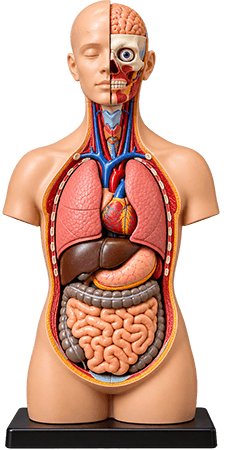
Anatomy Model – desktop accessory for showing the different body systems and organs, purchase on Amazon