
Teaching students to write a formal lab report can feel… ambitious. Many of them are used to worksheets, short answers, and quick reflections, not multi-page scientific writing. But helping students learn to communicate like scientists is one of the most important skills we can give them. A well-written lab report shows not just what they did, but what they understood.
I do not have students write many lab reports, as most of the labs I do in class end with a summary or a list of questions to check for understanding. However, I believe it is important that students at least understand what goes into a formal lab report. Many students who go on to higher education in science will need to do formal lab reports.
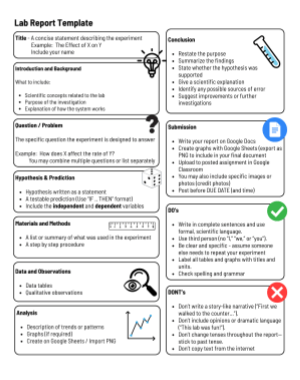
I created this guide on Canva, but you can use it as a template to tailor it to your course or specific lab.
What’s in a Lab Report?
A lab report is more than an assignment, it’s training in scientific thinking. Writing about an investigation helps students:
- Organize their thoughts
- Make claims using evidence
- Analyze data instead of just collecting it
- Create graphs and charts from their data
- Practice real-world science communication
I created this reference sheet to help students organize their lab report. The guide also includes a check list to ensure that each element is included in the lab. I use a generic rubric for grading the lab, which can also work for future labs.
Students will use Google Sheets to create their graphs. I use this sample sheet for the lab on catalase enzymes.
Tips for Helping Students Succeed
Here are strategies that consistently make a difference:
- Write one section together as a class before students write independently.
- Give targeted feedback, not feedback on every single mistake in the first draft.
- Let students revise – real scientific writing always includes revision.
- Keep a lab report rubric consistent across all labs.
- Incorporate peer review – have students check other students with the rubric to identify missing elements
Related Documents
AP Biology Class Site – includes resources for all units in this class
Investigation: Catalase Activity in Yeast – students create alginate spheres with activated yeast and observe how the spheres float in hydrogen peroxide.
Investigation: Amylase and Carbohydrates – use Benedict’s test to observe how starch is converted into sugars
Animal Behavior and Habitat Selection – explore how pillbugs respond to different environments