Cow Eye Virtual Dissection
Google Doc Version | Google Slides
Overview of Slides
- Slide 1: Eye Dissection (Remote Edition): View the video and attend the class demonstration to prepare for labeling eye structures on the slides.
- Slide 2: Identify the clear cornea, the white sclera, and the eyelashes used to keep debris out of the eye.
- Slide 3: Locate the rope-like optic nerve on the back of the eye, often hidden in fat and tissue.
- Slide 4: A scalpel is used to separate the front and back halves of the eye, guided by the cornea.
- Slide 5: Locate the jelly-like vitreous humor and the dark, wheel-shaped iris.
- Slide 6: The pupil is the central opening exposed when the iris is removed and adjusts in response to light.
- Slide 7: The lens, which focuses light, is embedded in the vitreous humor and looks like a mentos candy.
- Slide 8: The retina contains photoreceptors, and the optic disk is a "blind spot" where nerves converge.
- Slide 9: Removing the retina reveals the blue, reflective tapetum, which helps many animals see in the dark.
- Slide 10: Drag labels (Cornea, Tapetum, Lens, Iris) to the appropriate, separated eye structures.
- Slide 11: Quiz slide: Identify various structures based on their provided descriptions.
Diagram of the Eye
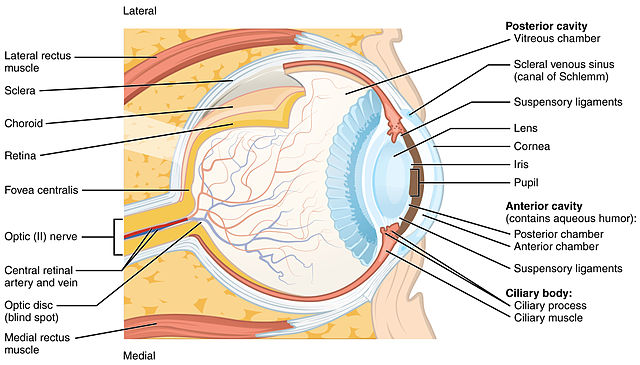
General Procedure for Eye Dissection
1. Cut the fat around the eye.
2. Puncture the cornea with scissors or a scalpel. The cornea is pinned here.
3. Cut the eye into a front and a back half.
4. Open the eye. The gelatinous fluid inside is the vitreous humor, the lens sits within this liquid.
5. Separate the parts of the eye. The lens is the hard, sphere-shaped structure sitting on (or in) the vitreous humor.
6. On the back of the eye, the thin layer of cells of the retina can be seen here, it is very thin and easy to pull away. The spot where they remain attached is the optic disk, which connects the retina to the optic nerve.
7. The tapetum is clearly visible with the retina removed. It is blue and shiney and will reflect light. This helps a cow to see in the dark. Notice on this photo, you can see the optic disk, the spot where the retina is still attached.
8. This student has carefully removed the iris, which can be difficult to get out in one piece. The hole in the center of the iris is the pupil.
9. These eye parts are separated so that you can clearly see the main structures.
10. The optic nerve can be seen on the back side of the eye, the nerve is usually buried within the fat, so it takes some work to find it and expose it.