DNA - DEOXYRIBONUCLEIC ACID
The Structure of DNA
- blueprint of life (has the instructions for making an organism)
- established by James Watson and Francis Crick
- codes for your genes
- shape of a double helix
- made of repeating subunits called nucleotides
Gene - a segment of DNA that codes for a protein, which in turn codes for a trait (skin tone, eye color..etc), a gene is a stretch of DNA.
Nucleotide - consists of a sugar, phosphate and a base

Nucleotides (also called Bases)
Adenine, Thymine, , Guanine, Cytosine or A, T, G, C
Nucleotides pair in a specific way - called the Base-Pair Rule
Adenine pairs to Thymine
Guainine pairs to Cytosine
Memory helper - think "A T Granite City") - which is where you live
*The rungs of the ladder can occur in any order (as long as the base-pair rule is followed)
How the code works
Those 4 bases have endless combinations just like the letters of the alphabet can combine to make different words. Endless combinations result in different traits, appearances, and functions of the organism
For example: compare these stretches of DNA for a fictional organism
A A A T T A T T T = curly tails
A A A T T A G G G = straight tails
A A A T T A C C C = no tails
DNA REPLICATION
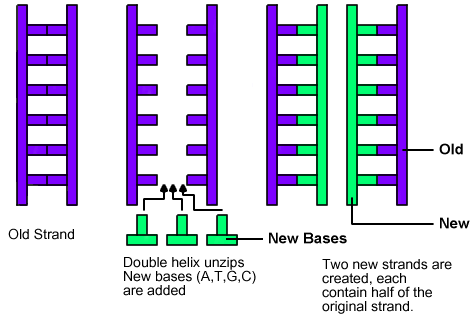
Replication is the process where DNA makes a copy of itself. Why does DNA need to copy? Simple: Cells divide for an organism to grow or reproduce, every new cell needs a copy of the DNA or instructions to know how to be a cell. DNA replicates right before a cell divides.
DNA replication is semi-conservative. That means that when it makes a copy, one half of the old strand is always kept in the new strand. This helps reduce the number of copy errors.
RNA
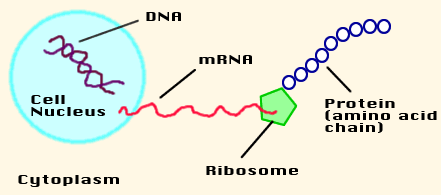
DNA remains in the nucleus, but in order for it to get its instructions translated into proteins, it must send its message to the ribosomes, where proteins are made. The chemical used to carry this message is Messenger RNA
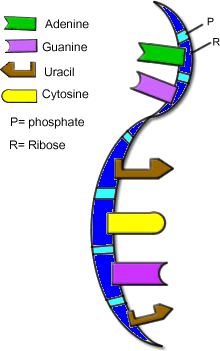
RNA = ribonucleic acid.
RNA is similar to DNA except:
1. has on strand instead of
two strands.
2. has uracil instead of thymine
3. has ribose instead of deoxyribose
mRNA has the job of taking the message from the DNA to the nucleus to the ribosomes.
Transcription - RNA is made from DNA
Translation - Proteins are made from the message on the RNA

Additional Notes: