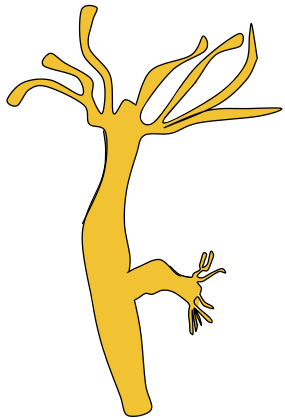
Exploring Hydra: A Microscopic Journey


Materials: Slides of preserved hydra (budding) or living specimens of hydra, microscopes
Objective: By the end of this lesson, students will be able to:
- Identify the key anatomical features of a hydra under the microscope.
- Count the tentacles and observe budding structures on a hydra specimen.
- Understand the basic characteristics of hydra and its reproductive processes.
Overview of the Hydra
Hydra is a small, freshwater organism belonging to the phylum Cnidaria. It is one of the simplest multicellular animals, characterized by its tubular body shape and radial symmetry. Here are some key features of the hydra:
-
Body Structure: The hydra has a cylindrical body with a single opening at one end called the oral opening or mouth. This opening is surrounded by several tentacles, typically ranging from 5 to 10 in number, although this can vary between species and individuals.
-
Tentacles: The tentacles of the hydra are specialized structures used for feeding and defense. Each tentacle is armed with stinging cells called nematocysts, which contain venomous harpoon-like structures used to immobilize prey and deter predators. The tentacles also contain sensory cells that help the hydra detect and capture prey.
-
Reproduction: Hydra reproduces both sexually and asexually. Asexual reproduction occurs through budding, where small outgrowths called buds develop on the body of the hydra and eventually detach to form new individuals. Sexual reproduction involves the release of gametes (sperm and eggs) into the surrounding water, where fertilization occurs externally.
-
Regeneration: One of the most remarkable features of the hydra is its ability to regenerate lost body parts. If a hydra is cut into several pieces, each piece has the potential to regenerate into a complete individual, given the right conditions. This remarkable regenerative ability has made hydra a model organism for studying regeneration and stem cell biology.
-
Habitat: Hydras are found in freshwater habitats such as ponds, lakes, and slow-moving streams. They are typically attached to submerged vegetation or other surfaces, although they can also move by crawling or somersaulting using muscular contractions.
-
Feeding: Hydras are carnivorous organisms that feed primarily on small aquatic invertebrates such as tiny crustaceans and insect larvae. When prey comes into contact with the tentacles, the nematocysts are triggered, injecting venom and immobilizing the prey. The tentacles then bring the prey to the mouth, where it is ingested and digested in the gastrovascular cavity.
Prelab Questions:
1. How is the hydra classified? Identify the Kingdom and Phylum.
2. What are nematocysts?
3. Where do hydra live?
4. What do hydra eat?
5. How do hydra reproduce?
6. What is regeneration?
View a Hydra
Obtain a slide of a living or preserved hydra and observe under scanning and low power. DO NOT use high power.
7. Draw the hydra as it appears at 40x (scanning) and label the basal disk, tentacles and the gastrovascular cavity.
Use an arrow to indicate where the mouth of the hydra is (you may not be able to see it on your specimen)
8. Count the number of tentacles on your specimen. How many are there? ___
Compare this number to other hydra in the room. Do all hydra have the same number? ____
If someone asks you "how many tentacles do hydra have?" How would you answer?
9. A single tentacle has several nematocysts which can be viewed as small bumps on the surface of the tentacle. Nematocysts contain the stinging cells (cnidocytes). Sketch a tentacle as it appears at 100x (low power) and label the nematocysts.
Estimate the number of nematocysts on a single tentacle: ________
10. Sketch a food web showing the hydra and other aquatic organisms.
Related Activities
Article: Hydra and Other Cnidarians
Slides and Overview of Sponges and Cnidarians