30-1 The Chordates Reading Guide
...................................Name ______________________________
1. Members of phylum Chordata are called _________________________________________.
2. A chordate is an animal that has a dorsal, hollow __________________________________;
a notochord; ______________________ pouches; and a _______________________
3. The hollow nerve cord runs along the { FRONT or BACK } of the body. (circle
one)
4. Most chordates have a notochord as adults only. { TRUE or FALSE }
5. Pharyngeal pouches may develop into gills in chordates such as _______________
and _____________________________________.
Match the description on the left with its chordate characteristic
a. Notochord................b. Tail.............c.
Pharyngeal pouch.............d. Hollow nerve cord
_____ 6. Connects nerves to internal
organs, muscles & sense organs
____ 7. Long supporting rod located just below nerve cord
_____ 8. Paired structure in throat region
_____ 9. Contains bone and muscle
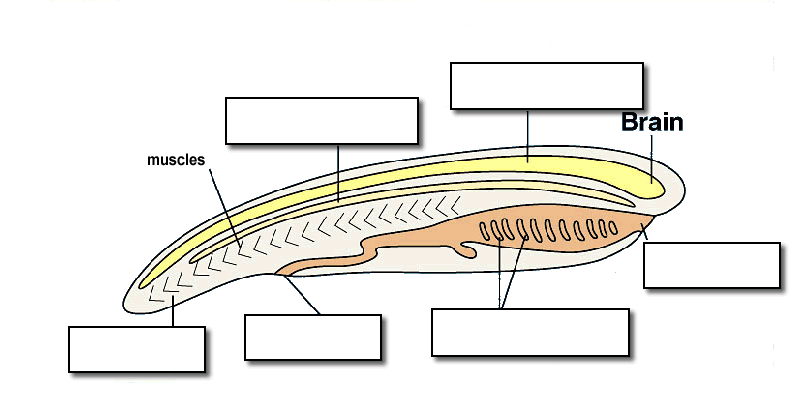
10. Label the Chordate
11. About ___________% of all chordates are placed in subphylum ________________________
12. The dorsal, hollow nerve cord is called the ________________________________in
vertebrates
13. The notochord is replaced with _____________________ in vertebrates and
is made up of individual segments called ____________________.
14. A vertebrate's backbone is part of an ________________________________.
15. Look at figure 30 - 2 page 768 Ò To which other vertebrate group
are birds most closely related?_____________________________________________________
16. The two groups of nonvertebrate chordates are ______________________________
and _________________________________________________
17. Tunicates belong to subphylum _______________________________________.
18. Most tunicates are commonly known as __________________________________.
19. Lanceletes belong to subphylum _________________________________________.
20. What makes an adult lancelet different from the adult tunicate? ________________________
21. What does a lancelet use its pharynx for? ____________________________________
22. Lancelets have a ________________________ circulatory system.
23. Lancelets have a true heart. { TRUE or FALSE }