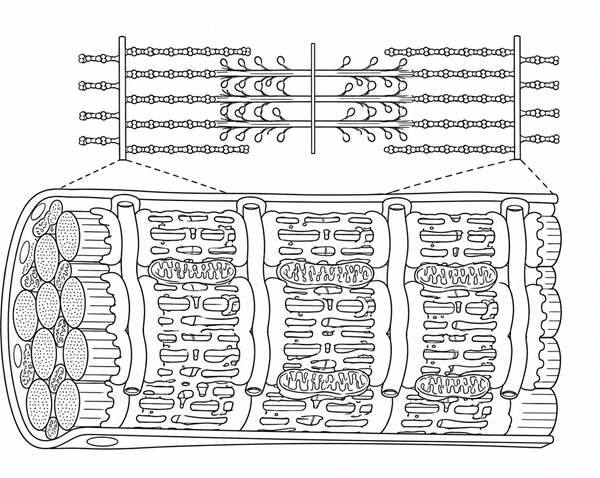
Muscle Fiber Coloring Worksheet: Sarcomere Structure & Skeletal Muscle Anatomy
*Updated 2026*


Structures of the Sarcomere
- Sarcomere – The repeating contractile unit of a muscle fiber. It shortens during contraction, causing the entire muscle to contract.
- Thin (Actin) Filaments – Protein filaments attached to the Z discs. They slide toward the center of the sarcomere during muscle contraction.
- Thick (Myosin) Filaments – Protein filaments located in the center of the sarcomere. Myosin heads bind to actin and pull the thin filaments inward using ATP.
- Z Disc (Z Line) – The boundary of each sarcomere. It anchors the thin filaments and moves closer to adjacent Z discs during contraction.
- A Band – The dark region containing the entire length of the thick filaments. Its length remains the same during contraction.
- I Band – The light region containing only thin filaments. It becomes narrower as the muscle contracts.
- H Zone – The central area of the A band where only thick filaments are present. It decreases in width or disappears during contraction.
- M Line – The center of the sarcomere. It contains proteins that hold the thick filaments together and keep them aligned.
- Myofibril – A long bundle of repeating sarcomeres inside a muscle cell. Myofibrils are responsible for generating the force of muscle contraction.
- Sarcoplasmic Reticulum (SR) – A specialized membrane network that surrounds each myofibril. It stores and releases calcium ions needed for muscle contraction.
- Terminal Cisternae – Enlarged sacs of the sarcoplasmic reticulum that store large amounts of calcium. They release calcium when the muscle receives a nerve signal.
- Transverse (T) Tubules – Deep invaginations of the sarcolemma that carry electrical impulses into the interior of the muscle fiber, ensuring all sarcomeres contract at the same time.
- Triad – A structure formed by one T tubule and two terminal cisternae. It coordinates the release of calcium in response to a muscle impulse.
- Sarcolemma – The plasma membrane surrounding a muscle fiber. It conducts electrical signals that trigger muscle contraction.
- Mitochondria – Organelles that produce ATP through cellular respiration. Muscle cells contain many mitochondria to provide the energy required for repeated contractions.