Echinoderms
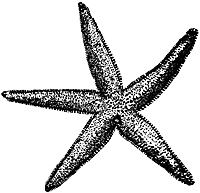 Starfish,
sand dollars, and sea urchins all belong to a group (phylum) of invertebrates
known as echinoderms. The word "echinoderm" means spiny skin,
which describes most of the organisms in this phylum. Echinoderms all
live in water and are predators or scavengers, the underside of the animal
has a mouth and their arms are used to pry open shelled prey such as mollusks.
Starfish,
sand dollars, and sea urchins all belong to a group (phylum) of invertebrates
known as echinoderms. The word "echinoderm" means spiny skin,
which describes most of the organisms in this phylum. Echinoderms all
live in water and are predators or scavengers, the underside of the animal
has a mouth and their arms are used to pry open shelled prey such as mollusks.
One of the more unusual aspects of echinoderms is their ability to regenerate lost arms. A starfish that loses an arm can grow a new one if just a couple of weeks. Echinoderms are radially sysmetrical, which is obvious from the way their stars (which can vary in number) radiate from the mouth opening.
Echinoderms are usually found in the shallow water near the shore. They spend much of the time resting in the sand or on rocks. Starfish can move using specialized structures called tube feet. Each arm of the starfish has hundreds of tubes with suckers on them to help them navigate over rocks and sand. The suction of the tube feet is powerful enough to open even the most stubborn clam shell. The movement and circulation of a sea star is accomplished by canals within the animal that fill with water, a system called the water vascular system.
 Echinoderms
do not have a highly developed nervous system, but they do have a nerve
ring that surrounds the mouth and helps to coordinate their movements
and responses. Sensory cells on their arms gather information about their
surroundings, such as light and temperature to help the organism respond
to its environment.
Echinoderms
do not have a highly developed nervous system, but they do have a nerve
ring that surrounds the mouth and helps to coordinate their movements
and responses. Sensory cells on their arms gather information about their
surroundings, such as light and temperature to help the organism respond
to its environment.
Starfish are an important part of shoreline ecosystems. In one experiment, a starfish (Pisaster ochraceous) was removed from an area. This starfish was a predator of many mussel species in that location. With the starfish removed, it was thought that the mussels would achieve greater diversity. On the contrary, with the top predator gone, one particular species of mussel came to dominate the community and crowded out all of the other species. In this sense, the starfish is known as a "keystone" species, which is an animal that is important for maintaining a community's biodiversity. A relative of the starfish, the sea urchin, is an important part of kelp communities where sea otters live.
 There
are several distinct groups of echinoderms related to sea stars (also
known as starfish). Sea urchins and sand dollars are grouped together
because they have large solid plates that form around their soft bodies.
Sea urchins have hundreds of spines sticking off of their bodies, which
can serve as a defense against predators. Sand dollars tend to be flat
and will spend most of their time submerged under the sand in shallow
waters.
There
are several distinct groups of echinoderms related to sea stars (also
known as starfish). Sea urchins and sand dollars are grouped together
because they have large solid plates that form around their soft bodies.
Sea urchins have hundreds of spines sticking off of their bodies, which
can serve as a defense against predators. Sand dollars tend to be flat
and will spend most of their time submerged under the sand in shallow
waters.
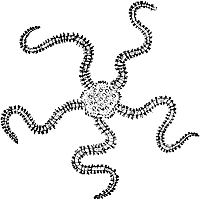
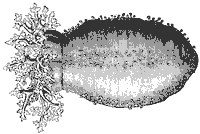
Brittle stars are a gorup of echinoderms found mainy on coral reefs. They have very long flexible arms that can break off (and regenerated later). These broken arms will continue to wiggle and move to distract a predator and allow the organism to escape. Sea cucumbers are odd little creatures that resemble a cucumbers, hence their name. Sea cucumbers usually feed on dead or decaying organic matter on the ocean floor.
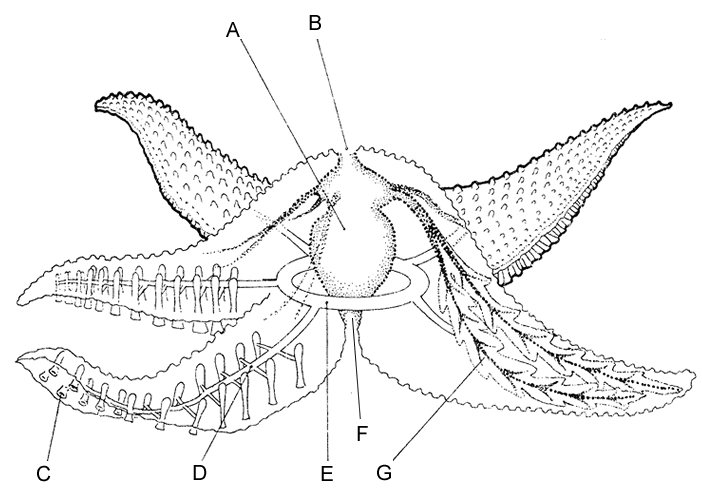
Anatomy of a Starfish - match the letter to the description
1. The anus is found on the
top of a starfish, this is where wastes are removed. _____
2. The mouth is on the opposite side of the anus, food is taken in here:
_____
3. Large and centrally located between the mouth and anus is the stomach,
where food is digested: ____
4. The ring canal surrounding the stomach, part of the starfish's water
vascular system: ____
5. The radial canal extends from the ring canal and into the starfish's
arms, also part of the vascular system: ____
6. Attached to the radial canal are the tiny tube feet with suckers: ____
7. Digestive glands are located within the arms of the starfish, chemicals
help break down food: _____
Questions:
___ 1. What type of echinoderm
has flexible arms that are easily broken to escape predators:
a) Brittle
Stars b) Sea Stars c) Sea Cucumbers d) Sea Urchins
___ 2. Sea stars belong to what Phylum? a) Invertebrata b) Arthropoda c) Nematoda d) Echinodermata
___ 3. How do most star fish get
their food?
a) Filter
feeding b) Scavenging c) Predation of small animals d) Eating plants and algae
___ 4. Which echinoderm is grouped with a sea urchin? a) sea cucumber b) sand dollar c) sea star d) brittle star
___ 5. An echinoderm that has a
large number of spines attached to it is probably a:
a) sand
dollar b) brittle star c) sea star d) sea urchin
___ 6. Ring canals and radial canals are both part of the ______ system. a) circulatory b) water vascular c) muscular d) digestive
___ 7. The process of regrowing body parts is called: a) regeneration b) homeostasis c) vasculation d) biodiversity
___ 8. What type of symmetry does a brittle star have? a) bilateral b) open-ended c) radial d) oblong
___ 9. Where is the anus of a starfish
located?
a) At the
end of an arm b) on its underside c) on its top side d) starfish do not have an anus
___ 10. A "keystone"
species is often a(n):
a) top predator b) endangered
species c) dominant species d) parasite
___ 11. Sea otters share their
habitat with what other important organisms?
a) starfish
& brittle stars b) kelp & sea urchins c) sea cucumbers & mussels d) whales & sharks
___ 12. If you remove the starfish
from a shoreline area, what happens to the mussel populations:
a) they
become extinct b) one species crowds out all of the others c) the area becomes more biodiverse
___ 13. The word "echinoderm" means: a) big foot b) hairy toe c) tube feet d) spiny skin
 This work is licensed under a Creative Commons Attribution-NonCommercial-ShareAlike 4.0 International License.