Review Questions


1. Identify the simple machine described:
An inclined plane wrapped in a spiral around a post __________________________
Has a pivot point between the load and input force __________________________
A sloping flat surface used to raise objects. __________________________
An inclined plane with one or two sloping sides. __________________________
Can be fixed or moveable, consists of a rope wrapped around a wheel__________________________
A bar that is free to pivot around a fixed point. __________________________
2. Give an example of each type of simple machine
Wheel and Axle __________________________ Screw __________________________
Inclined Plane __________________________ Lever __________________________
Pulley __________________________Wedge__________________________
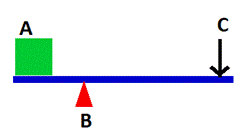
3. Identify the parts of this lever
A___________________________
B___________________________
C ___________________________
4. What type of lever is pictured? ________________
5. If you place a 100 N load at point A on the lever. What force would be needed to balance it at point C. No calculations necessary, use your “best guess”. a. 100 N b. 200 N c. 50 N
6. If B was perfectly centered, what force would balance a 100N load at point A? a. 100 N b. 200 N c. 50 N
7. Draw a diagram of a class 2 lever and identify the fulcrum, load and effort.
Name a tool that acts as a class 2 lever: ____________________________
8. Draw a diagram of a class 3 lever and identify the fulcrum, load and effort.
Name a tool that acts as a class 3 lever: ____________________________
9. Define WORK: _________________________________________________
What is the equation used to calculate work? _________________________
What unit is work measured in? _____________
10. Define POWER: ________________________________________________
What is the equation used to calculate power? _________________________
 What unit is work measured in? _____________
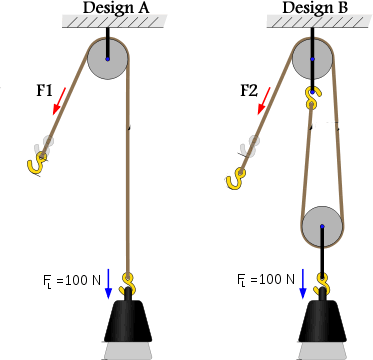
11. Examine the two pulley designs…
Which one has the greatest MECHANICAL ADVANTAGE? _____
If 100 N of force are required in design A (F1), how much force would be necessary for design B (F2). The distance of the rope in design B is double that of design A. _________
Which design is a Block and Tackle? ______
Which one is a fixed pulley? _______
12. What is MECHANICAL ADVANTAGE? How is it calculated?
What can increase the mechanical advantage of a wheel and axle? ____________________________
What can increase the mechanical advantage of an inclined plane? ____________________________
What can increase the mechanical advantage of lever? _________________________
13. You will also have problems to do for the test. Here are two samples.
A) How much work is done pushing a block 200 m with a force of 30 newtons?
B) You push a stroller a distance of 10 meters, the amount of work expended is 2500 J. What is the force used in pushing the stroller?
C) A motor has a power of 300 W. How much work can be done by this motor in 30 seconds?
