Animal Behavior


Animal behavior or ethology is studied through various methods and approaches to understand the actions, interactions, and adaptations of animals.
Behavior - An action or series of actions performed in response to a stimuli
Ethology - the study of animal behavior
Innate Behavior: genetically based, animals are born with the ability to perform behavior (sometimes we call these instincts)
Learned Behavior- the development of behaviors through experience
How Animals Are Studied
Animal behavior or ethology is studied through various methods and approaches to understand the actions, interactions, and adaptations of animals. Here are some common techniques used in the field of ethology:
1. Observational Studies: Ethologists often spend time observing animals in their natural habitats. This involves recording behaviors, interactions, and environmental factors without directly interfering with the animals. Observations can be done through visual observation, camera traps, or other non-invasive methods.
2. Field Experiments: Researchers design experiments in natural settings to test hypotheses about animal behavior. These experiments might involve manipulating certain variables to observe the animals' responses, such as changes in their environment or introducing specific stimuli.
3. Laboratory Experiments: Controlled environments in laboratories allow scientists to study animal behavior in a more controlled setting. These experiments can manipulate conditions precisely and measure responses more accurately.
4. Comparative Studies: Ethologists compare behaviors across different species to understand similarities, differences, and evolutionary relationships. This approach involves studying behaviors across a range of animals to draw conclusions about the evolutionary origins and adaptive significance of behaviors.
Types of learning
Habituation
Classical Conditioning (Pavlov's dogs)
Operant Conditioning (Skinner box)
Insight Learning (Reasoning, only found in intelligent animals, primates)
Imprinting: birds are geneticaly programmed to follow the first thing they see when they hatch (usually mom)
Animal Communication
Dogs give several nonverbal cues to communicate with other dogs (and humans)
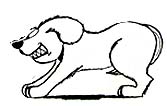 This
dog might look mean, but notice the tail between the legs, he's actually
frightened and may bite out of fear
This
dog might look mean, but notice the tail between the legs, he's actually
frightened and may bite out of fear
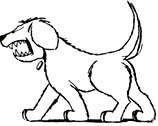 This dog is acting agressively, maybe to tell another dog or a human who's
boss
This dog is acting agressively, maybe to tell another dog or a human who's
boss
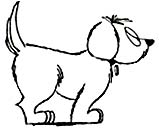 This dog is alert and attentive.
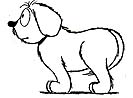 This dog is being submissive, ears are down tail is between the legs
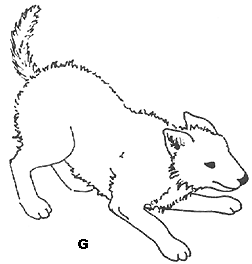 This dog is lowering the front of his body, this is usually an invitation
to play (called a play bow)
This dog is lowering the front of his body, this is usually an invitation
to play (called a play bow)
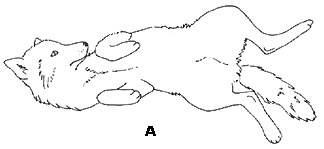 This
dog is in an extreme submissive position, exposing his belly to the dominant
dog in the pack.
This
dog is in an extreme submissive position, exposing his belly to the dominant
dog in the pack.
Primate Communication
Primates can communicate basic concepts but humans are the only animals with a true LANGUAGE
Language is learned in humans by trial-and-error. Babies "babble" and parents reinforce meaningful words. As language develops, humans learn to rearrange words and symbols to mean different things.
Social Behavior
Animals that live in groups have structure and "rules". Examples: chimpanzee troops, insect colonies, wolf packs, humans
Honeybees communicate through complex mechanisms, including pheromones, dances, and tactile cues. The famous "waggle dance" performed by worker bees communicates the direction and distance of food sources to other members of the colony.
Competition - occurs between animals over resources (space, food, water, mates) and includes territorial behavior
Resources on Animal Behavior
Territorial Behavior in Crickets - mark and observe crickets as they interact with each other
Isopod Behavior Lab (with lab report) - AP Lab 11 modified experiments with pill bugs