The Peripheral Nervous System
Peripheral Nervous System - consists of the nerves that branch out from the CNS and connect it to other body parts, also includes the cranial nerves
Somatic Nervous System (conscious activities)
- skin, skeletal systemAutonomic Nervous System (unconscious activities)
- heart, viscera, glands
CRANIAL NERVES (12 pairs)
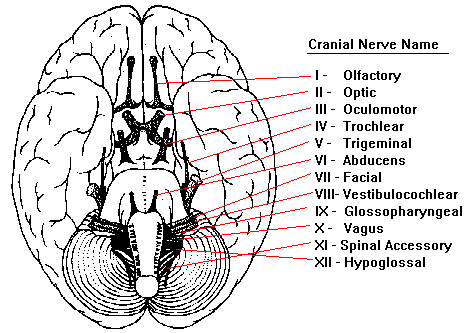
-
Olfactory (I): This nerve is associated with the sense of smell. It transmits information about odors from the nose to the brain.
-
Optic (II): The optic nerve is crucial for vision, carrying visual information from the eyes to the brain's visual centers.
-
Oculomotor (III): Responsible for controlling most eye movements and pupil constriction, this nerve helps in focusing and controlling the position of the eye.
-
Trochlear (IV): This nerve controls the superior oblique muscle of the eye, aiding in downward and inward eye movement.
-
Trigeminal (V): One of the largest cranial nerves, the trigeminal nerve has sensory functions for the face, including touch, pain, and temperature sensations, as well as controlling the muscles used for chewing.
-
Abducens (VI): This nerve controls the lateral rectus muscle of the eye, aiding in outward eye movement.
-
Facial (VII): Responsible for facial expressions, taste sensation from the front two-thirds of the tongue, and controlling tear and saliva production.
-
Vestibulocochlear (VIII): Also known as the auditory or acoustic nerve, it's associated with hearing and balance, transmitting information from the inner ear to the brain.
-
Glossopharyngeal (IX): Involved in taste sensation at the back of the tongue, swallowing, and sensory information from the throat and back of the tongue.
-
Vagus (X): The vagus nerve is incredibly important, influencing the heart rate, digestion, and various other involuntary bodily functions. It also plays a role in speech and swallowing.
-
Accessory (XI): This nerve controls certain muscles in the neck, particularly those used for head movement and shoulder shrugging.
-
Hypoglossal (XII): Responsible for controlling the muscles of the tongue, aiding in speech and swallowing.
 There is a mnemonic to help you remember the 12 cranial nerves:
On Old Olympus Towering Top, A Finn And German Viewed A Hop
Each letter corresponds with the first letter of the cranial nerves.
Assignment: Cranial Nerves Coloring
SPINAL NERVES (31 pairs)
These are not named individually, they are grouped according to the level from which they arise
8 pairs of cervical nerves (C1 -
C8)
12 pairs of thoracic nerves (T1-T12)
5 pairs of lumbar nerves (L1-L5)
5 pairs of sacral nerves (S1-S5)
1 pair of coccygeal nerves (Co)
*Spinal cords ends at the level between
the 1st and 2nd lumbar vertebrae
*The lumbar, sacral, coccygeal nerves descend from the end of the cord - CAUDA
EQUINA (horse's tail)
Each nerve emerges from the spinal cord at points called ROOTS
Dorsal Root Ganglion - arises from the back side of the spinal cord
Ventral root ganglion - arises from the front side
Plexuses
Main portions of the spinal nerves combine to form complex networks called PLEXUSES
CERVICAL PLEXUSES
*phrenic nerves (diaphragm). neck
BRACHIAL PLEXUSES
*shoulders, arms, hands
* Ulnar, median, radial, axillary nerves
LUMBROSACRAL PLEXUSES*pelvic area, genitalia, buttocks, thighs, legs, feet
*Obturator, femoral, sciatic nerves
*intercostals nerves (ribs)
AUTONOMIC NERVOUS SYSTEM
SYMPATHETIC - Energy, high stress, emergency; FIGHT or FLIGHT
PARASYMPTHETIC - restful, ordinary
*Divisions act antagonistically, one turns on (exhitatory), other turns off (inhibitory)
Cell body --> Preganglionic fiber (axon) leaves CNS and synapses with neurons in the autonomic ganglion --> Postganglionic fiber (axon)
Autonomic Neurotransmitters
Cholinergic fibers (acetylcholine)
Adrenergic fibers (norepinephrine)